
Immunohistochemistry Resource Guide
Not enough time to read now ?

Table of Contents
Immunohistochemistry Selection Guide
Avidin-Biotin Complex (ABC)-Based Detection
Choosing a VECTASTAIN® ABC Kit
> Customizing your VECTASTAIN® ABC Kit
ImmPRESS® One-Step Polymer Systems
> ImmPRESS® Two-Step Amplified Polymer Systems
> Choosing an ImmPRESS® Polymer Kit
> Multiple Antigen Labeling Simplified
M.O.M.® (Mouse on Mouse) Immunodetection Kits
> Counterstain/Substrate Compatibility Table
Avidin-Biotin Complex (ABC)-Based Detection
Modular and versatile with high sensitivity and low background
ABC-based detection is one of the most widely-used methods for staining. This ABC method exploits the high affinity exhibited between the protein avidin and the vitamin biotin. Avidin is tetravalent, so each avidin molecule can bind up to four biotinylated conjugates. In the ABC method, avidin and biotinylated enzyme is combined to form large macromolecular complexes containing multiple enzyme molecules. These added complexes bind to any biotinylated target, such as primary or secondary antibodies, nucleic acids, lectins, and macromolecules. When the chromogenic enzyme substrate is applied, it yields a colored precipitate at the site of the reaction. The large multi-enzyme complexes of the ABC method amplify the signal, providing greater sensitivity.
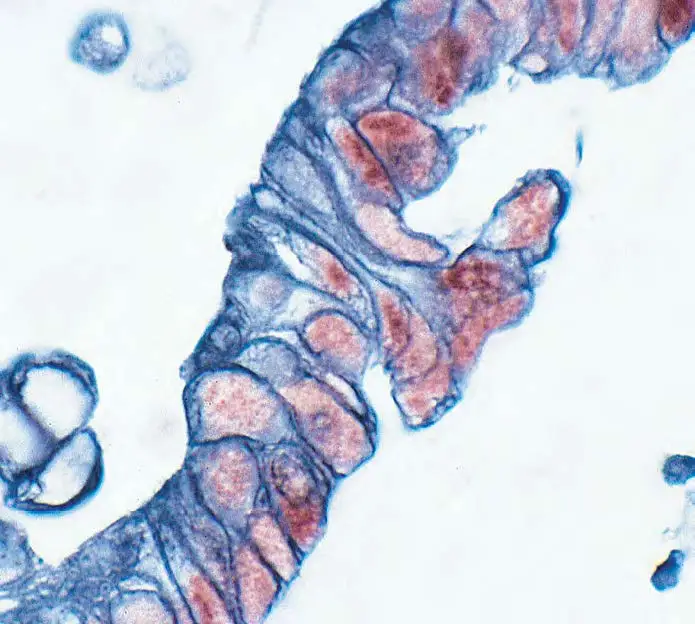
Tumor: • p53 (m), VECTASTAIN® Elite® ABC Kit, Vector® NovaRED® (red) • Cytokeratin (s), VECTASTAIN® Elite® ABC Kit, Vector® SG (blue-gray).