Immunohistochemistry Resource Guide
Not enough time to read now ?

Table of Contents
Immunohistochemistry Selection Guide
Avidin-Biotin Complex (ABC)-Based Detection
Choosing a VECTASTAIN® ABC Kit
> Customizing your VECTASTAIN® ABC Kit
ImmPRESS® One-Step Polymer Systems
> ImmPRESS® Two-Step Amplified Polymer Systems
> Choosing an ImmPRESS® Polymer Kit
> Multiple Antigen Labeling Simplified
M.O.M.® (Mouse on Mouse) Immunodetection Kits
> Counterstain/Substrate Compatibility Table
Counterstaining
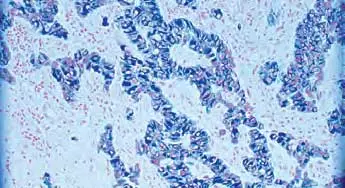
A counterstain introduces color to specific cellular structures to provide contrast to the colored enzyme substrate. Counterstaining aids in visualization and target localization, facilitating interpretation of morphology and cell structure within the tissue section. Our nuclear counterstains are packaged as convenient, ready-to-use solutions for use on individual slides or in staining dishes. Vector® Hematoxylin (blue)
- Based on Gill’s III formulation
- Progressive stain formula. The intensity can be adjusted to optimize results for either manual or automated systems
- Excellent color contrast with most commonly used peroxidase and alkaline phosphatase substrates
- Suitable for use with non-aqueous and aqueous mounting media
- Alcohol- and mercury-free
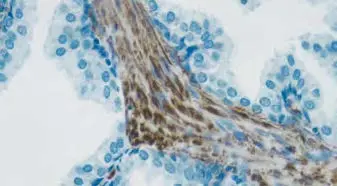
Tumor tissue section showing specific cytoplasmic cell staining (Vector DAB, brown) with Vector Hematoxylin QS counterstain (blue).
- Modification of Mayer’s hematoxylin developed especially forimmunocytochemistry
- Ready-to-use without filtration or ‘blueing’ step
- Stains in less than 45 seconds
- Excellent color contrast with most commonly used peroxidase and alkaline phosphatase substrates
- Suitable for use with non-aqueous and aqueous mounting media
- Mercury-free
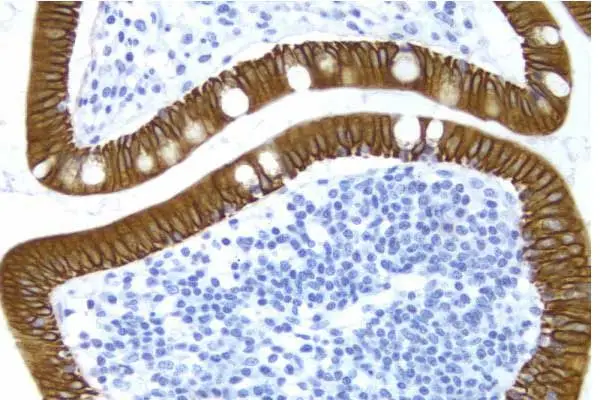
- Superior formulation of methyl green suitable for use with a wide range of enzyme substrates
- Simple, two step procedure
- Excellent alternative in multiple antigen labeling when hematoxylin obscures the substrate colors
- Suitable for use with non-aqueous mounting media
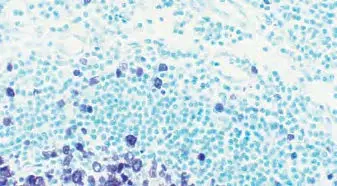
Vector Nuclear Fast Red (pink)
- Fast one-step protocol
- Excellent alternative in multiple antigen labeling when hematoxylin obscures the substrate colors
- Good contrast with a variety of substrates