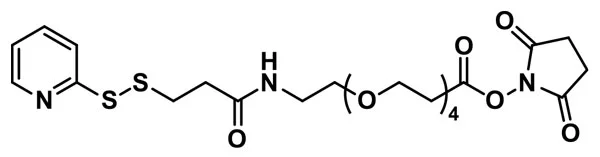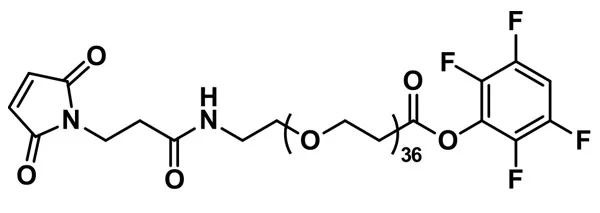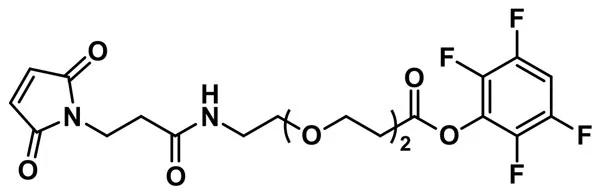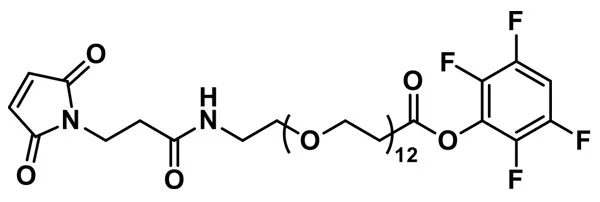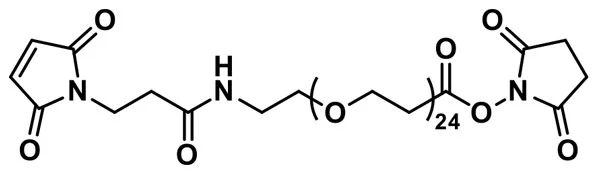
CAS Number 756525-99-2 | |
Molecular Weight 513.50; single compound | |
Chemical Formula C₂₂H₃₁N₃O₁₁ | |
Purity > 98% | |
Unit Size 100 mg, 1000 mg | |
Solubility Methylene chloride, Acetonitrile, DMAC or DMSO. | |
Spacers dPEG® Spacer is 22 atoms and 24.8 Å | |
Storage Instructions -20°C; Always let come to room temperature before opening; be careful to limit exposure to moisture and restore under an inert atmosphere; stock solutions can be prepared with dry solvent and kept for several days (freeze when not in use). dPEG® pegylation compounds are generally hygroscopic and should be treated as such. This will be less noticeable with liquids, but the solids will become tacky and difficult to manipulate, if care is not taken to minimize air exposure. | |
Shipping Instructions Ambient |
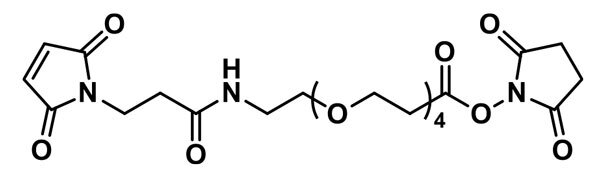
MAL-dPEG®₄-NHS ester
MAL-dPEG®4-NHS ester, product number QBD-10214, is a crosslinking reagent that joins a sulfhydryl to a free amine. The sulfhydryl groups react with a maleimide group via a Michael addition reaction. The amines form amide bonds with the crosslinker by nucleophilic substitution of the N-hydroxysuccinimidyl (NHS) ester of a carboxylic acid group. The maleimide and NHS functional groups on the crosslinking compound sit at either end of a short, discrete-length polyethylene glycol (dPEG®) chain.
The reactions that join free amines to free thiols are among the most popular, most useful crosslinking reactions in bioconjugate chemistry. These reactions require heterobifunctional reagents that bridge the two different reactive groups. Traditional crosslinkers are hydrophobic molecules, but our dPEG® crosslinking products are single molecular weight PEG compounds with discrete chain lengths.
The conjugation of conventional hydrophobic crosslinking reagents to biomolecules almost inevitably triggers problems such as aggregation and precipitation of the conjugates. These problems do not occur with our water-soluble, non-immunogenic dPEG® crosslinkers.
With these crosslinkers, the NHS ester end of the molecule must conjugate to a target molecule before the maleimide end of the molecule. At pH 7.0 – 7.5, NHS esters react optimally with free amines. However, NHS esters can react with free amines with pH as low as 6.0. As the pH increases, the hydrolysis rate of the ester increases. Thus, we strongly discourage storing MAL-dPEG®4-NHS ester in water or aqueous buffers. Instead, we recommend that customers make new solutions of the product as needed, use them immediately, and discard unused solutions after use.
The reaction of the maleimide end of MAL-dPEG®4-NHS ester, QBD-10214, with a sulfhydryl proceeds optimally at pH 6.5 – 7.5. Use the lowest reasonable pH within this range. Above pH 7.5, free amines compete with free thiols at the maleimide reaction site, which can cause confusing results. Moreover, at higher pH values, the maleimide ring may open to form unreactive maleamic acid.
Numerous scientific papers, patents, and presentations have published the uses of MAL-dPEG®4-NHS ester, QBD-10214. The following list highlights some of the more important uses of this product:
Development of therapeutic antisense drugs;
Development of active and passively targeted nanoparticles;
Development of vaccines;
Development of nanoparticle-based photodynamic therapy;
Development of Gd-doped CuS nanoparticles for imaging and targeted photothermal treatment of gastric tumors;
Development of antibody-drug conjugates;
Development of extracellular antibody-drug conjugates; and,
Development of multiplex assays.
Price range: $164.00 through $278.00
| SKU | Unit Size | Price |
|---|---|---|
Select a unit size:
How do I request a quote or bulk pricing?
Documents |