CAS Number 1252257-56-9 | |
Molecular Weight 735.87; single compound | |
Chemical Formula C₃₁H₄₉N₃O₁₃S₂ | |
Purity > 97% | |
Unit Size 100 mg, 1000 mg | |
Solubility Methylene chloride, Acetontrile, DMAC, DMSO or water. | |
Spacers dPEG® Sp | |
Storage Instructions -20°C; Always let come to room temperature before opening; be careful to limit exposure to moisture and restore under an inert atmosphere; stock solutions can be prepared with dry solvent and kept for several days (freeze when not in use). dPEG® pegylation compounds are generally hygroscopic and should be treated as such. This will be less noticeable with liquids, but the solids will become tacky and difficult to manipulate, if care is not taken to minimize air exposure. |
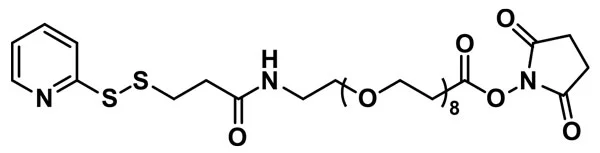
SPDP-dPEG®₈-NHS ester
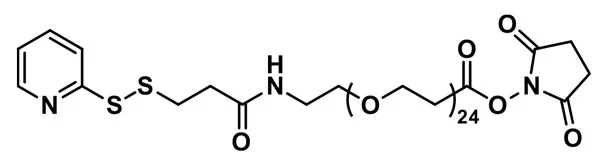
SPDP-dPEG®8-NHS ester, product number QBD-10376, is a medium-length (32 atoms), hydrophilic, non-immunogenic, heterobifunctional crosslinker that has the same functionality as the widely popular, but unfortunately hydrophobic, SPDP crosslinker. It contains an amine-reactive N-hydroxysuccinimidyl (NHS) ester on one end of the dPEG®8 linker, and a thiol-reactive SPDP (also known as OPSS) reactive group on the other end.
Among the most popular heterobifunctional crosslinking reagents used in bioconjugate chemistry are those compounds that conjugate molecules containing free amine groups with molecules that contain sulfhydryl groups. SPDP (N-succinimidyl 3-(2-pyridyldithio)-propionate) is one of the most popular versions of this type of crosslinker. Unfortunately, SPDP and its popular varieties (LC-SPDP and Sulfo-LC-SPDP) are hydrophobic molecules. When conjugated to biomolecules, care must be taken not to modify the target molecules too much, because this can precipitate the conjugate products.
By contrast, SPDP-dPEG®8-NHS ester, product number QBD-10376, is used like SPDP and its related hydrophobic products. However, precautions against overly modifying the target molecule are not necessary. The water-soluble dPEG® product will not cause the resulting conjugates to precipitate due to excessive hydrophobicity.
Price range: $273.00 through $1,311.00
| SKU | Unit Size | Price |
|---|---|---|
Select a unit size:
How do I request a quote or bulk pricing?
Documents |