
Revisiting Colon Cancer Metastasis Through a Glycobiology Lens

Colon carcinoma, also known as colorectal cancer, is among the top three most common cancer types for men and women in the United States and is the second leading cause of cancer deaths globally [1]. The high incidence of this form of cancer and its relatively poor prognosis lead scientists to explore new research and therapeutic avenues.
Protein glycosylation, or the attachment of a carbohydrate to a protein backbone, impacts cell function in normal and abnormal ways. Because of this, protein glycosylation is a promising pathway to understanding the metastatic progression of colon carcinoma, develop better diagnostic assays, and unlock potential treatments. Glycosylation of key biomarkers has been associated with colon carcinoma. Specifically, increased sialylation, or the addition of sialic acid to the terminal end of a glycan chain attached to a protein, of carcinoembryonic antigen (CEA) has been associated with cancer metastasis [2].
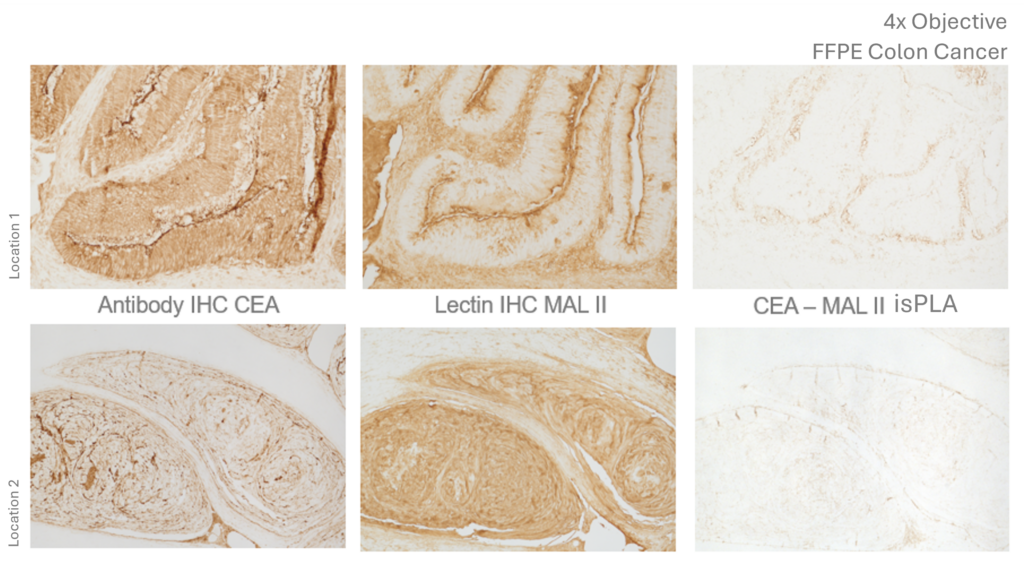
In FFPE colon cancer tissues, in situ Proximity Ligation Assay (isPLA) using the Glysite™ Explorer isPLA Glycan Detection Kit (GEK-1000) with anti-CEA antibody and MAL II Glysite Explorer Lectin (GEK-1269) showed specific cellular patterns (Figure 1). These patterns are created from puncta at the site of proximity between glycans and proteins, revealing where glycan and protein interaction may occur. Detection of specific glycoforms of proteins may reveal disease-relevant alterations not captured by protein or glycan expression alone.
To aid researchers in exploring this significant dimension in cancer research, Vector Laboratories makes accessible a suite of tools like validated lectins and integrated kits for probing glycan interactions. For the detection of glycan expression in tissue sections, Glysite™ Scout Glycan Screening Kits leverage curated lectins to detect all major glycan motifs to evaluate distribution in a target specimen. The Glysite Scout Kit can be used to compare glycan expression in healthy and diseased tissue states, including in colon carcinoma research (view our poster for more information). For a more detailed look at protein glycosylation patterns in cells and tissues, the Glysite™ Explorer Kit provides an integrated way to spatially examine glycan and protein proximity. Built on robust isPLA technology and purpose-built lectins, Glysite Explorer is a novel tool that makes visualizing protein glycosylation patterns in FFPE cells and tissues more accessible than ever.
For colon carcinoma and other cancers, glycosylation is an oft overlooked but critical component in disease characterization, pathogenesis, and treatment. Whether researchers are discovering or validating cancer biomarkers, exploring disease progression mechanisms, or investigating potential therapeutic avenues, tools like Glysite Scout and Glysite Explorer Kits enable an expanded view of cancer biology by integrating glycosylation analysis into standard workflows. For more information on glycobiology research tools, browse Vector Laboratories’ glycobiology kits, NCFG-validated lectins, and more.
References
- Chen, J., Yang, L., Li, C., Zhang, L., Gao, W., Xu, R., & Tian, R. (2023). Chemical Proteomic Approach for In-Depth Glycosylation Profiling of Plasma Carcinoembryonic Antigen in Cancer Patients. Molecular & cellular proteomics : MCP, 22(11), 100662. https://doi.org/10.1016/j.mcpro.2023.100662
- Siegel, R. L., Kratzer, T. B., Giaquinto, A. N., Sung, H., & Jemal, A. (2025). Cancer statistics, 2025. CA: A Cancer Journal for Clinicians, 75(1), 10–45. https://doi.org/10.3322/caac.21871