
Unit Size 1 Kit | |
Storage Instructions Store reagents in original bottles at 4°C. Do not freeze.
| |
Usage Summary Each Glysite Explorer Lectin is sufficient to perform 50 reactions when using 100uL per reaction. Prior to use, Explorer Lectin (50x) should be diluted to 1x with Protein Diluent.
| |
Applications Immunohistochemistry, Glycobiology | |
Purchase Note Purchase note | |
Sample Type FFPE Tissues, FFPE Cell Pellets, Fixed Cells |
The Glysite™ Explorer in situ PLA Glycan Detection Kit
The Glysite™ Explorer in situ PLA Glycan Detection Kit is a fully integrated tool for the spatial detection of glycans proximal to a protein of interest in FFPE tissues, FFPE cell pellets and fixed cells. This system integrates a curated panel of Vector’s Glysite™ Explorer Lectins with Navinci’s proprietary in situ Proximity Ligation Assay (isPLA). Researchers can flexibly select specific Glysite™ Explorer Lectins covering the major categories of glycan types to pair with a primary antibody targeting their protein of interest. This provides a simple approach to understand glycan-protein proximity with a spatial context.
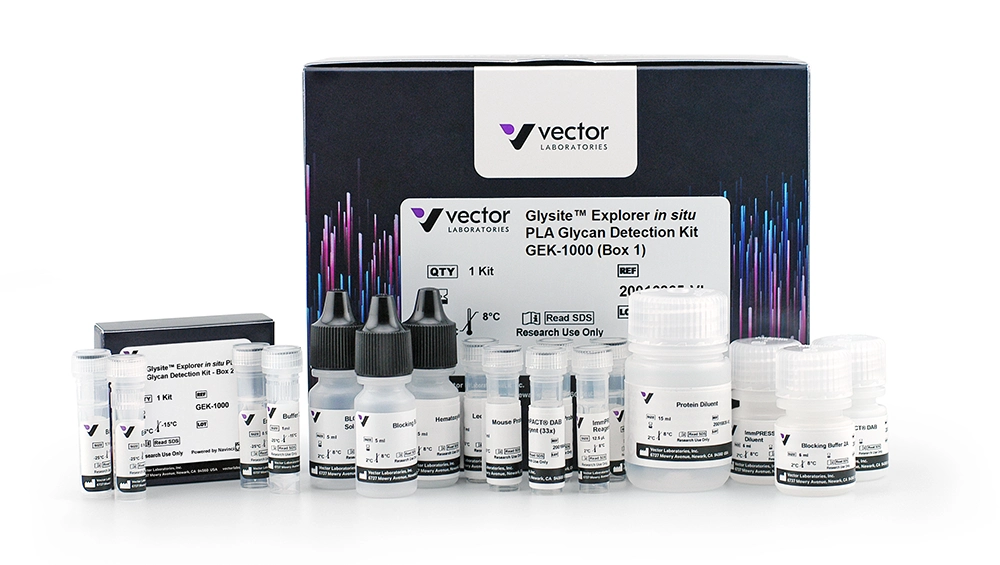
The Glysite™ Explorer in situ PLA Glycan Detection Kit (GEK-1000) provides all core reagents needed for the workflow. To complete your assay, please select at least one Glysite™ Explorer Lectin (up to 10) and supply your primary antibody of choice.
Price range: $75.00 through $2,500.00
Kit Components
Box 1 Reagents (4°C storage, do not freeze):
Box 2 Reagents (-20°C storage):
|
Technical Information The Glysite™ Explorer in situ PLA Glycan Detection Kit leverages Vector’s well-known immunohistochemistry portfolio and lectins with Navinci’s proven isPLA technology. This assay enables researchers to detect glycosylation proximal to specific proteins in a spatial context.
A B C D Simplified scheme of Glysite™ Explorer in situ PLA Glycan Detection Kit. A. Lectin binds to target glycan and primary antibody binds to target protein. B. Oligo probes bind to primary antibody and lectin. C. When oligo probes are in proximity (~40nm), ligation occurs. D. Amplification and detection produces a colored precipitate at the site of proximity. Recommended experiments before using the Glysite™ Explorer in situ PLA Glycan Detection Kit:
| |
Spectral Information Spectral |

Publications refs |
Product FAQs
Which Glysite™ Explorer Lectins are available and what glycan structures do they detect?
The Glysite Explorer Kit is designed to be used with Glysite Explorer Lectins that target specific glycan motifs. The following lectins are currently available:
- WGA Lectin: Terminal GlcNAcβ, Terminal GlcNAcα, Terminal N-acetyl–containing glycans
- LCA Lectin: α1-6 fucose
- PHA-L Lectin: β1-6 branched N-glycans; binds tri- and tetraantennary structures
- ECL Lectin: Terminal type 2 LacNAc, Terminal type 2 LacdiNAc
- Jacalin Lectin: Core 1 and Core 3 O-glycans; 3-substituted GalNAcα
- GNL Lectin: Terminal α1-3 or α1-6 mannose
- MAL II Lectin: α2-3–sialylated Galβ1-3GalNAc in O-glycans; 3′-sulfated Galβ
- SNA Lectin: α2-6–sialylated LacNAc, α2-6–sialylated LacdiNAc
- WFA Lectin: Terminal GalNAcβ, Terminal GalNAcα, Terminal multiantennary LacNAc
- AAL Lectin: α-fucose
What is the Glysite™ Explorer in situ PLA Glycan Detection Kit (GEK-1000)?
It is a highly sensitive spatial detection method that identifies protein-glycan proximity through the use of DNA-labeled probes and a DNA amplification technology.
What are the minimum and maximum distances (between the glycan and the protein) that can be detected by the kit?
The Glysite Explorer Kit allows the visualization of a glycan and a protein when they are within 40nm of each other.
Do I need to buy any other reagents to complete the staining protocol?
Customers will need to purchase a Glysite Explorer Lectin, and for additional reagent requirements, please see the User Guide.
What species of tissue are compatible with the Glysite Explorer Kit?
- The Glysite Explorer kit has been validated on human specimens.
- Other species of tissues should also be compatible, but the primary antibody species should be selected to avoid endogenous IgG detection.
What types of specimens can be used with the Glysite Explorer Kit?
The Glysite Explorer Kit has been validated on formalin-fixed, paraffin-embedded (FFPE) tissues, FFPE cells, and fixed cells. The kit is not recommended for use on frozen tissue specimens at this time.
Can this kit be used with thick (>10µm) sections or free-floating sections?
- The concentrations and incubation times in the Glysite Explorer Kit have been optimized for 4-6 µm sections. We have not evaluated the performance of this kit on thick sections or free-floating sections.
- For users who want to stain thick sections, the protocol will need to be modified.
Which species of primary antibodies are compatible with the Glysite Explorer Kit?
- The Glysite Explorer Kit includes two separate secondary antibody reagents: one anti-mouse and one anti-rabbit. This allows users to pair either a mouse or a rabbit primary antibody with their chosen Glysite Explorer Lectin, depending on the needs of the experiment.
- We do not recommend the use of a primary antibody from the same species as the tissue being studied—for example, do not use a mouse primary on mouse tissue—to minimize nonspecific binding and reduce the risk of false-positive signals from endogenous IgG.
Can the researchers perform both IHC and isPLA on the same specimen?
- Multiplexing with the Glysite Explorer Kit is generally not recommended.
- This kit has not been validated to perform multiplexing. In some cases, it may be possible if detection reagents do not cross-react and the proper controls are included.
What experimental controls do you recommend when using the Glysite Explorer Kit?
- Positive controls
- Characterize the expression of the protein of interest in your specimen using standard Immunohistochemistry (IHC), Immunofluorescence (IF) or other workflows.
- Determine the optimal dilution for the primary antibody in a standard IHC assay as this will be the recommended starting dilution for the isPLA assay.
- Characterize the expression of the glycan of interest in your specimen using standard Immunohistochemistry (IHC), Immunofluorescence (IF) or other workflows.
- Characterize the expression of the protein of interest in your specimen using standard Immunohistochemistry (IHC), Immunofluorescence (IF) or other workflows.
- Negative control:
- Omit the Glysite Explorer Lectin and/or primary antibody from the workflow to demonstrate whether non-specific binding or background staining is present.
What reagent volume should be applied to my specimen?
Reagent volumes should be determined by the researcher to align with the dimensions of their specimens. Volumes sufficient to cover the specimens should be applied, and samples should not be allowed to dry out during the incubation steps.
How many specimens can I stain with the Glysite Explorer Kit?
The number of specimens that can be stained will vary depending on specimen size. The Glysite Explorer Kit provides 5 mL of working solution. If using 50-100µL of reagent per slide, there is sufficient volume to stain 50-100 specimens.
What mounting medium should I use?
Slides stained with the Glysite Explorer Kit can be mounted with either an aqueous or a non-aqueous mounting medium. For non-aqueous mounting, we recommend using VectaMount® PT Permanent Mounting Medium (H-5600-60) or VectaMount® Express Mounting Medium (H-5700-60). For aqueous mounting, we recommend using VectaMount® AQ Aqueous Mounting Medium (H-5501-60).
What will my positive signal look like?
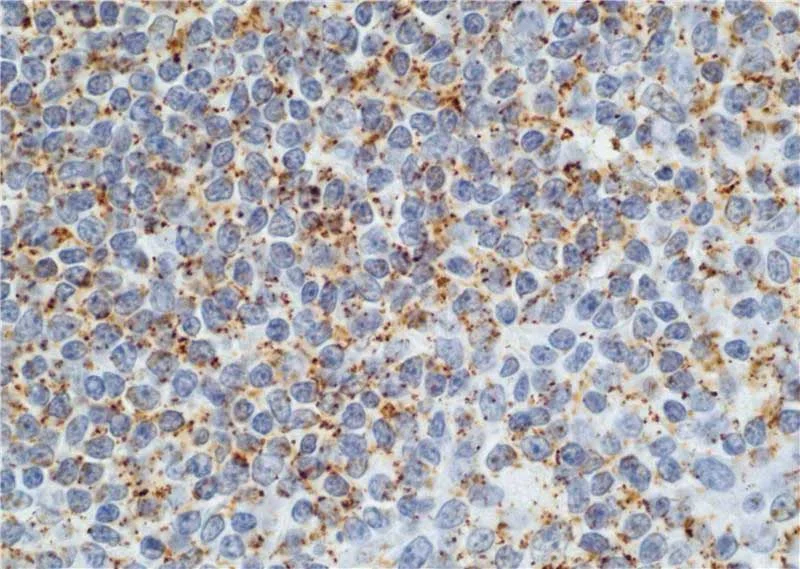
- The Glysite Explorer Kit generates distinct, round signals called puncta at the site of proximity. These are best visualized using at least a 20x objective, and sometimes a 40x may be required, especially when epitope density is low.
- If the counterstain is too dark, it can obscure isPLA signals. Hematoxylin QS incubation should be optimized for each specimen to ensure positive signals are not masked. Even 1 second of staining is often sufficient, if performed at all.
- The overall appearance will vary by specimen and proximal target abundance.
What is the average run-time for the Glysite Explorer Assay?
The average run-time will depend on the duration of the primary antibody incubation. If your primary antibody incubation is 30 minutes, the total run time is approximately 8 hours.
Is there a step in the assay where I can pause the assay?
If the assay cannot be completed within a single day, the tissue sections can be stored overnight at 4°C in Protein Diluent after incubation of the Lectin Solution in step 13. Do not allow the sample to dry out.
Can I use another peroxidase substrate with the Glysite Explorer Kit?
The kit is supplied with ImmPACT DAB, Vector’s most sensitive peroxidase substrate. Other peroxidase substrates can be substituted, and the Glysite Explorer Kit has been validated with ImmPACT® NovaRed (Catalog Number: SK-4805), ImmPACT® VIP (SK-4605), and ImmPACT® SG (SK-4705). However, not all peroxidase substrates are equivalent in sensitivity and staining quality and should be optimized to achieve desired results.
Is the kit available with a fluorescent readout?
No, the Glysite Explorer Kit is not currently available with a fluorescent readout.
What are the storage conditions for this kit and the lectins?
- The Glysite Explorer Kit is supplied in two boxes, and the labels indicate the proper storage conditions. Box 1 should be stored at 4°C. Box 2 should be stored at -20°C.
- The Glysite Explorer Lectins should be stored at 4°C.