
Call for Collaboration: Spatial Glycosylation Detection with Glysite Explorer

When researchers design a protein expression study, the standard toolkit of IHC, IF, flow cytometry, and other techniques can tell them a great deal about where a protein is and how much of it is present. What those methods typically leave out is glycosylation: the post-translational modification that in many cases determines how a protein functions. Mass spectrometry can detect glycosylation, but it destroys spatial context in the process and requires instrumentation and expertise that most labs don’t have in-house. The result is that protein glycosylation goes unstudied in tissue—not because it isn’t relevant, but because until recently, there was no straightforward way to look.
The Glysite™ Explorer in situ PLA Glycan Detection Kit overcomes these limitations by providing a robust, standardized, and spatially resolved platform for studying protein glycosylation that plugs directly into your IHC or PLA workflows. For a limited time, add Glysite Explorer to your research and you could get your kit purchase reimbursed.
Seeing Protein Glycosylation In Situ with Glysite Explorer
As a first-of-its-kind, fully integrated solution, the Glysite™ Explorer™ in situ PLA Glycan Detection Kit combines a curated panel of Glysite™ Explorer Lectins with Navinci’s in situ Proximity Ligation Assay (isPLA) technology to enable reliable detection and visualization of protein glycosylation in true spatial context.
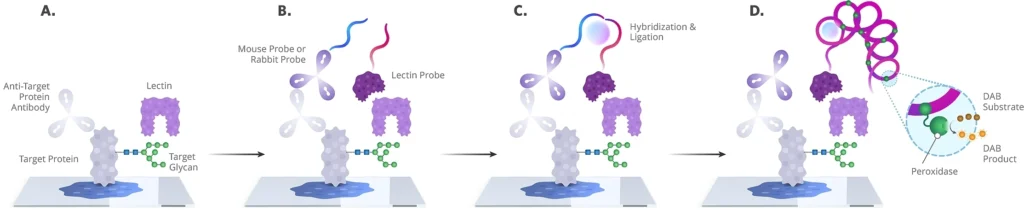
Glysite™ Explorer provides a reproducible platform for in situ detection of glycan-protein proximity in native biological context using an immunostaining-style workflow compatible with standard microscopy and image analysis pipelines. The assay delivers same-day results and is validated across multiple tissue types, enabling spatially informed glycosylation insights with speed and confidence.
Dr. Steven Barthel and Dr. Tobias Schatton co-direct the Program of Glyco-Immunology and Oncology (PGIO) at Brigham and Women’s Hospital, Harvard Medical School and noted that “Without this product, we would not have been able to easily characterize diverse glycan structures on the cellular target protein of interest or compare glycan motifs across distinct cell types of the tumor microenvironment.”
Their teams use the Glysite™ Explorer isPLA Glycan Detection Kit to explore the proximity of glycans to immune checkpoint proteins in melanoma cells and a variety of immune cell subsets. This data will add to the growing understanding of the impact of glycosylation on the tumor microenvironment and cancer progression.
Because glycosylation is ubiquitous, the ability to study glycosylated proteins with spatial context using the Glysite™ Explorer Kit has broad impact across life sciences, accelerating therapeutic discovery, biopharmaceutical development, glycan biomarker studies, earlier disease detection, and improved patient stratification.
Additionally, Vector Laboratories has been highly commended for the 2026 CiteAb Innovation Award, recognizing the impact of the Glysite Explorer Kit in advancing glycosylation research.
Seeing Protein Glycosylation in Cancer Research
The following articles highlight how adding protein glycosylation analysis to cancer research using tools like Glysite Explorer deepens understanding.
- The Overlooked PTM: Making Glycosylation More Accessible to Researchers
- Revisiting Colon Cancer Metastasis Through a Glycobiology Lens
- Glycosylation in the Alzheimer’s Brain: Visualizing New Paths to Diagnosis and Therapy
- Advancing Colorectal Cancer Research with Biomarker-Driven Tools
- A New Focus for Breast Cancer: Protein Glycosylation’s Emerging Role
- Glycans and Immune Checkpoints: Revealing Hidden Influences on Cancer Immunotherapy
Call for Collaboration
Vector Laboratories is inviting researchers to participate in our Glysite Explorer Call for Collaboration: an opportunity to add spatial glycosylation data to your existing studies and receive a full rebate on your kit cost in return.
This program is open to academic researchers, translational scientists, and biopharma teams working in areas where glycosylation is relevant to their biology of interest. If you study glycoproteins, immune checkpoints, tumor microenvironments, or other contexts where the where of glycosylation matters, we’d like to hear from you.
How to participate:
Purchase the Glysite Explorer Kit, generate data with it, and submit that data within 60 days of receiving your kit. Upon receipt and acceptance of qualifying data, Vector Laboratories will issue a full store credit rebate for the cost of the kit. Participation and rebate issuance are at the discretion of the Vector Laboratories team. This rebate program is for U.S. based researchers purchasing directly from www.vectorlabs.com.
Register Your Interest
If you are interested in visualizing protein glycosylation and collaborating with Vector Laboratories, fill out the form below and a member of our team will reach out to you with further information.