Molecular Weight 104 | |
Color of Fluorescence Red | |
Extinction Coefficient 1.2 | |
Formulation 10 mM HEPES, 0.15 M NaCl, pH 7.5 0.08% sodium azide, 0.1 mM CaCl2, 0.01 mM MnCl2, 5 mM mannose | |
Inhibiting or Eluting Sugar Mixture of a-methyl-mannoside & a-methyl-glucoside | |
Maximum Emission 570-580 nm | |
Maximum Excitation 545-555 nm | |
Unit Size 25 mg | |
Storage Instructions 2-8 °C | |
Sugar Specificity Terminal α-mannose (Man3-Man9), and biantennary N-glycans | |
Usage Summary The recommended concentration range for use is 5-20 µg/ml. | |
Applications Immunofluorescence, Glycobiology | |
Concentration 5 mg active conjugate/ml | |
Conjugate Rhodamine |
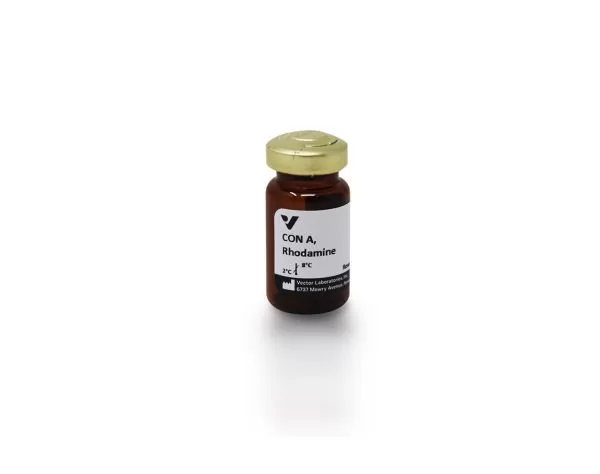
Concanavalin A (Con A), Rhodamine
Con A recognizes α-linked mannose present as part of a “core oligosaccharide” in many serum and membrane glycoproteins.
Rhodamine labeled Con A has an appropriate number of fluorochromes bound to provide the optimum staining characteristics for this lectin. This conjugate is supplied essentially free of unconjugated fluorochromes. The excitation maximum is at 550 nm and the emission maximum is at 575 nm.
$253.00
| SKU | Unit Size | Price |
|---|---|---|
Select a unit size:
How do I request a quote or bulk pricing?
Technical Information At neutral and alkaline pH, Con A exists as a tetramer of four identical subunits; below pH 5.6, Con A dissociates into active dimers of 52 kDa. Acetylation, succinylation, or other derivatizations can also produce stable forms with dimeric structures. (See succinylated Con A). Nicks in the sequence are often present in the purest preparations due to hydrolytic damage within the seeds. Con A requires calcium or manganese ions at each of its four saccharide binding sites. Although these divalent metal ions are bound tightly to the polypeptide structure, buffers which can bind calcium (such as phosphate) generally should be avoided in diluting Con A, since a gradual loss in activity may occur. Accompanying each fluorescent lectin is an analysis data sheet summarizing the results of our quality control tests and providing pertinent information on the product. All of these reagents are supplied as solutions preserved with sodium azide. Inhibiting/Eluting Sugar: mixture of 200 mM α-methylmannoside/200 mM α-methylglucoside |
 Powered by Bioz © 2023