CAS Number 488085-18-3 | |
Molecular Weight 937.03; single compound | |
Chemical Formula C₄₆H₆₈N₂O₁₈ | |
Purity > 98% | |
Unit Size 100mg, 1000mg | |
Solubility Methylene chloride, Acetontrile, DMAC or DMSO. | |
Spacers dPEG® Spacer is 40 atoms and 46.5 Å | |
Storage Instructions -20°C; Always let come to room temperature before opening; be careful to limit exposure to moisture and restore under an inert atmosphere; stock solutions can be prepared with dry solvent and kept for several days (freeze when not in use). dPEG® pegylation compounds are generally hygroscopic and should be treated as such. This will be less noticeable with liquids, but the solids will become tacky and difficult to manipulate, if care is not taken to minimize air exposure. | |
Shipping Instructions Ambient |
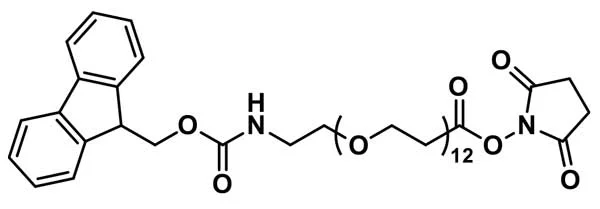
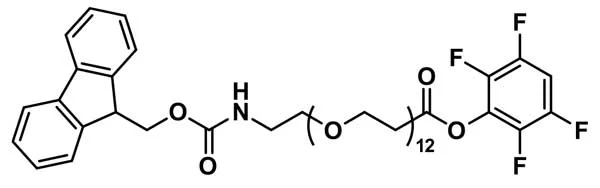
Fmoc-N-amido-dPEG®₁₂-NHS ester
Fmoc-N-amido-dPEG®12-NHS ester, product number QBD-10996 contains an Fmoc-protected amine on one end of a medium-length (40 atoms), single molecular weight, discrete-chain-length polyethylene glycol (dPEG®) spacer and the N-hydroxysuccinimidyl (NHS) ester of a propionic acid group on the other end. This product is ready for the direct introduction of a water-soluble, amphiphilic spacer into a peptide chain without the need to activate the carboxylic acid moiety. The Fmoc protecting group on the N-terminus of the molecule cleaves easily with standard peptide chemistry.
Fmoc-N-amido-dPEG®12-NHS ester permits our customers to insert a dPEG® spacer into a peptide chain using solid-phase or solution-phase chemistry. The spacer attaches at the N-terminal end of the peptide chain or on the free amine side chain of amino acids such as lysine. Additional peptide synthesis can be carried out to extend the peptide further, creating a peptide with a flexible, hydrophilic linker or spacer in the middle. Also, the dPEG® compound can provide spacing in a synthetic construct where steric hindrance is a problem. Amphiphilic, non-immunogenic dPEG® increases the hydrodynamic volume and improves the water solubility of the peptide while remaining soluble in organic solvents. The Fmoc protecting group is removed easily with a solution of piperidine in N,N-dimethylformamide (DMF).
Price range: $202.00 through $792.00
| SKU | Unit Size | Price |
|---|---|---|
Select a unit size:
How do I request a quote or bulk pricing?
Documents |