Enrichment Target Alkyne-modified proteins | |
Isolation Technology Biotin-streptavidin based capture | |
Unit Size 1 Kit | |
Storage Instructions 4C | |
Number of Enrichments 25 | |
Purchase Note Add some note | |
Quantity 25 | |
Shipping Instructions Ambient temperature |
Click-&-Go® Dde Protein Enrichment Kit *for enrichment of alkyne-modified proteins*
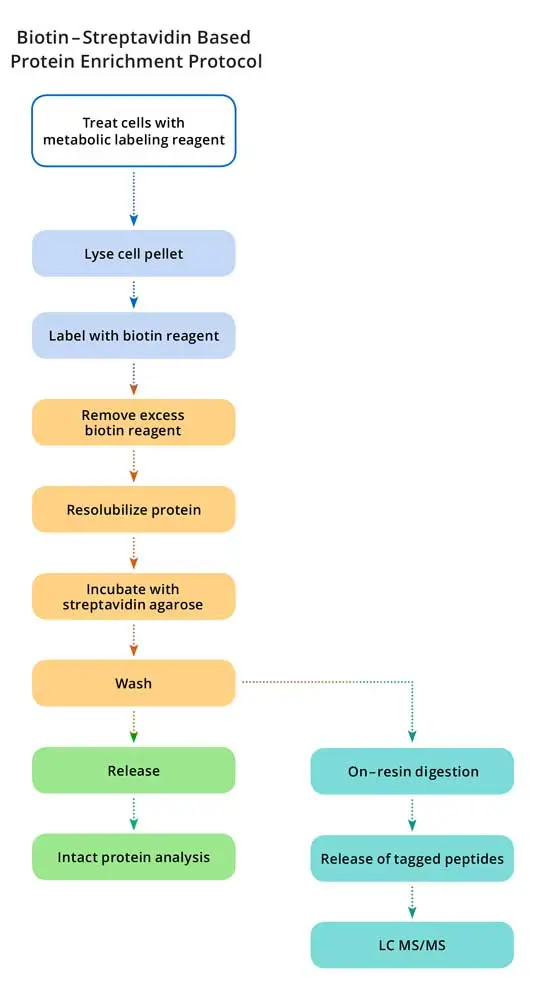
Extraordinary strength of the streptavidin-biotin interaction allows for efficient capturing of even highly dilute targets; however, it makes recovery of proteins from affinity resins challenging. Conventional methods to elute biotinylated proteins from immobilized avidin include the following: (i) denaturation of streptavidin by boiling the resin in a denaturing buffer that may include high concentrations of chaotropic salts, (ii) trypsin digestion of proteins while they are bound to the resin, or (iii) elution of proteins with excess free biotin. These protocols can co-elute contaminant proteins by releasing nonspecifically bound proteins and/or naturally biotinylated proteins concurrently with labeled proteins. In addition, some of these methods can cause elution of high levels of resin-based peptides along with the proteins of interest, resulting in further sample contamination.
Dde Biotin Azide probe eliminates a major limitation of the streptavidin-biotin affinity purification. This reagent contains a biotin moiety linked to an azide (N3) through a spacer arm containing a containing a hydrazine-cleavable Dde moiety. Captured biomolecules can be efficiently released under mild conditions (2% aqueous hydrazine solution), and the small molecular fragment (100.07 Da) left on the labeled protein following the cleavage. These features make the cleavable probe especially attractive for use in biomolecular labeling and proteomic studies.

$423.00
| SKU | Unit Size | Price |
|---|---|---|
Select a unit size:
How do I request a quote or bulk pricing?
Schematic Workflow
|
Documents |