
Glycosylation in the Alzheimer’s Brain: Visualizing New Paths to Diagnosis and Therapy

An estimated 22% of people aged 50 and above have Alzheimer’s Disease (AD) dementia, prodromal AD, and preclinical AD worldwide [1]. With a growing aging population, that number is expected to rise. To meet the needs of a significant global population, researchers are exploring the mechanistic underpinnings of AD for better diagnostics and therapeutic avenues.
An important piece of the neurodegenerative disease puzzle is protein glycosylation, a post-translational modification (PTM) in which sugar molecules called glycans attach to the backbone of proteins. Healthy cells carefully mediate this PTM for protein folding, developmental processes, and pathogen-host interactions, but disease states like AD are associated with dysregulated protein glycosylation.
AD-associated proteins like tau, APP, GFAP, CRMP-2, and TREM have been found to have abnormal glycosylation patterns in patients with AD [2]. The exact mechanisms by which abnormal glycosylation impact AD development are unclear, but these changes are increasingly recognized as promising avenues for gaining new insights into AD pathogenesis.
In FFPE brain tissues, in situ Proximity Ligation Assay (isPLA) using the Glysite™ Explorer isPLA Glycan Detection Kit (GEK-1000) with anti-GFAP antibody and SNA Glysite Explorer Lectin (GEK-1309) showed distinct pattern differences between healthy brain and cancerous brain (anaplastic adenocarcinoma; Figure 1). These patterns are created from puncta at the site of proximity between glycans and proteins, revealing where glycan and protein interaction may occur. Visual detection of protein glycosylation adds another layer of data to understand the diverse mechanisms impacting disease states.
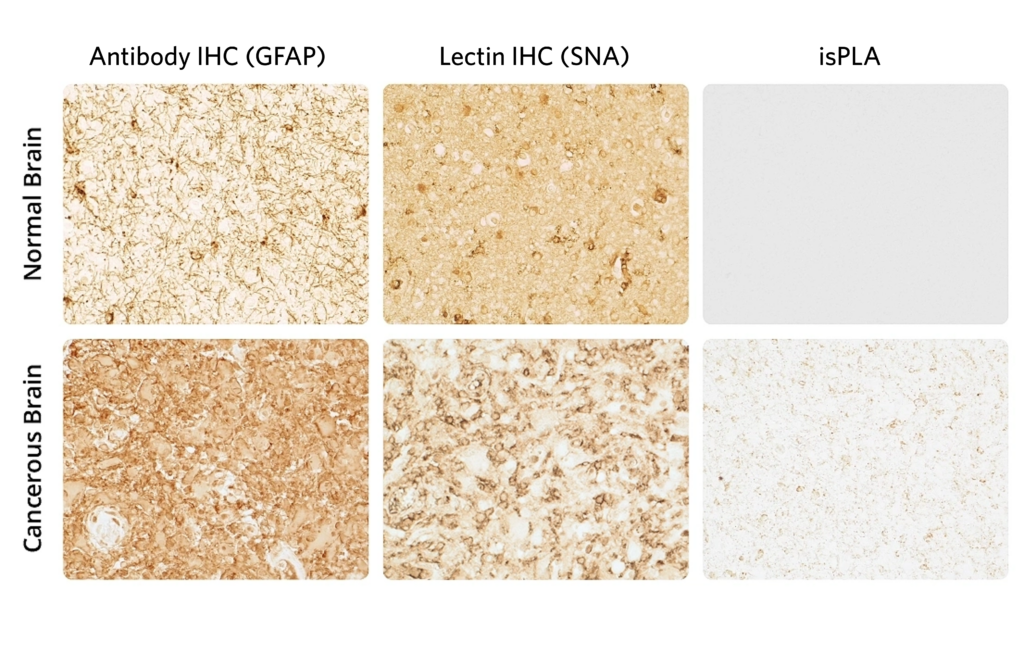
To ensure researchers have access to tools for probing the glycosylation state of AD research targets, Vector Laboratories developed integrated kits and validated lectins for probing glycan expression and protein-glycan proximity. The Glysite Explorer in situ PLA Glycan Detection Kit (GEK-2000) is the first commercially available, fully-integrated kit for visual detection of glycan-protein proximity in FFPE cells and tissues. This kit is ideal for orthogonal validation of glycan-mediate targets. For tissue samples where glycosylation changes are unknown, the Glysite™ Scout Glycan Screening Kit provides the tools you need to screen for mannose, complex N-glycan, core O-glycan, fucose, sialic acid, sulfation, GlcNAc, chitin, galactose, and LacNAc in a variety of tissue types. These kits, paired with our robust offering of purified lectins, make studying glycobiological insights more accessible to researchers.
Alzheimer’s Disease is complex disease on the rise worldwide. To explore every facet of this disease’s mechanisms and treatments, glycosylation must be considered. Vector’s suite of glycobiology reagents helps bridge understanding of this crucial PTM and its implication in neurodegenerative diseases.
References
- Gustavsson, A., Norton, N., Fast, T., Frölich, L., Georges, J., Holzapfel, D., Kirabali, T., Krolak-Salmon, P., Rossini, P. M., Ferretti, M. T., Lanman, L., Santuccione Chadha, A., & van der Flier, W. M. (2023). Global estimates on the number of persons across the Alzheimer’s disease continuum. Alzheimer’s & Dementia, 19(2), 658–670. https://doi.org/10.1002/alz.12694
- Zhao, J., & Lang, M. (2023). New insight into protein glycosylation in the development of Alzheimer’s disease. Cell Deah Discovery, 9, Article 314. https://doi.org/10.1038/s41420-023-01617-5