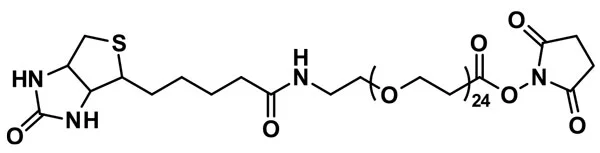
CAS Number 459426-22-3 | |
Molecular Weight 588.67; single compound | |
Chemical Formula C₂₅H₄₀N₄O₁₀S | |
Purity > 98% | |
Unit Size 50 mg, 1000 mg | |
Solubility Methylene chloride, Acetonitrile, DMAC or DMSO. | |
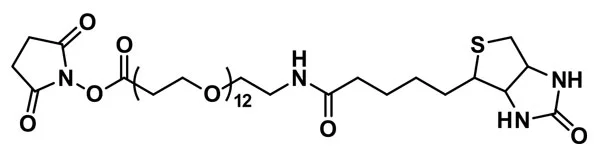
Spacers dPEG® Spacer is 16 atoms and 19.2 Å | |
Storage Instructions -20°C; Always let come to room temperature before opening; be careful to limit exposure to moisture and restore under an inert atmosphere; stock solutions can be prepared with dry solvent and kept for several days (freeze when not in use). dPEG® pegylation compounds are generally hygroscopic and should be treated as such. This will be less noticeable with liquids, but the solids will become tacky and difficult to manipulate, if care is not taken to minimize air exposure. | |
Shipping Instructions Ambient |
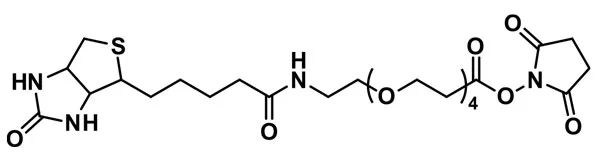
NHS-dPEG®₄-biotin
NHS-dPEG®4-biotin, product number QBD-10200, features biotin coupled to a short, discrete tetraethylene glycol (dPEG®4) spacer and functionalized with an N-hydroxysuccinimidyl (NHS) ester of propionic acid. The amphiphilic dPEG® spacer imparts flexibility and water solubility to the normally hydrophobic biotin moiety, while the NHS ester permits biotin conjugation to free primary amines such as the side chain of lysine. This popular compound is useful for assays and techniques requiring the biotin-avidin interaction.
NHS-dPEG®4-biotin provides superior performance to the widely used, but notoriously hydrophobic, NHS-LC-biotin. The amphiphilicity of QBD-10200 means that it can be dissolved in organic solvents and aqueous buffers with equal ease, and the flexible linker adds significant hydrophilicity to the conjugates formed with it. Notably, NHS-dPEG®4-biotin does not cause protein aggregation. This permits experiments that require high levels of biotin labeling to proceed without concerns about the loss of protein due to aggregation, which is a common problem when using NHS-LC-biotin. Dissolution of the product in organic solvent is not required for conjugation, thus providing easier reaction setup and greater reaction reproducibility. The dPEG® linker in PN10200 is slightly longer than the aminocaproic acid linker in LC-biotin; therefore, dPEG®4-biotin provides somewhat better access of the biotin to the avidin or streptavidin binding pocket compared to LC-biotin.
Price range: $153.00 through $665.00
| SKU | Unit Size | Price |
|---|---|---|
Select a unit size:
How do I request a quote or bulk pricing?
Documents |