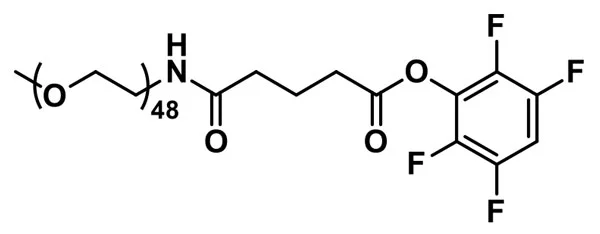
CAS Number N/A | |
Molecular Weight 1188.39; single compound | |
Chemical Formula C₅₃H₁₀₅NO₂₇ | |
Purity > 96% | |
Unit Size 100 mg, 1000 mg | |
Solubility Methylene Chloride, Acetonitrile, DMSO, DMAC or DMF. | |
Spacers dPEG® Spacer is 77 atoms and 91.3 Å | |
Storage Instructions -20°C; Always let come to room temperature before opening; be careful to limit exposure to moisture and restore under an inert atmosphere; stock solutions can be prepared with dry solvent and kept for several days (freeze when not in use). dPEG® pegylation compounds are generally hygroscopic and should be treated as such. This will be less noticeable with liquids, but the solids will become tacky and difficult to manipulate, if care is not taken to minimize air exposure. | |
Shipping Instructions Ambient |
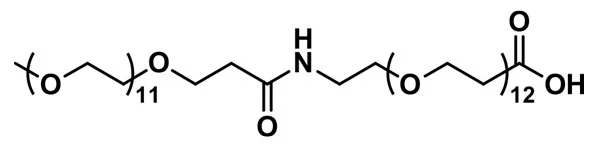
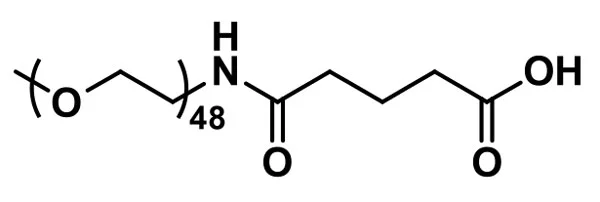
m-dPEG®₁₂-amido-dPEG®₁₂-acid
m-dPEG®12-amido-dPEG®12-acid, product number QBD-10148, is a long, methyl-capped, discrete chain length polyethylene glycol (dPEG®) spacer. The effective length of the dPEG® spacer is about 24 ethylene oxide units (i.e., m-dPEG®24-acid) with an amide bond in the middle of the chain. The reactive end of the molecule terminates in a propionic acid group. The terminal propionic acid moiety can be coupled directly to free amines using EDC or another carbodiimide. Alternatively, converting the reactive end into an active ester permits the conjugation of the transformed product to free amines. N-hydroxysuccinimide (NHS), 2,3,5,6-tetrafluorophenol (TFP), and 2,3,4,5,6-pentafluorophenol (PFP) are typically used for this purpose.
m-dPEG®12-amido-dPEG®12-acid, product number QBD-10148, reacts with amine-functionalized surfaces (carbon nanotubes, nanoparticles made of silica or various metals, quantum dots, and similar types of products) or free amines on biomolecules. When used to coat surfaces or modify biomolecules, m-dPEG®12-amido-dPEG®12-acid reduces or eliminates non-specific binding and increases water solubility. Crucially, the elimination of non-specific binding may increase the signal-to-noise ratio in imaging applications and assays where this is a consideration. Please note that modifying the surface amines of biomolecules with this uncharged, methyl-capped dPEG® spacer may alter the overall charge of the resulting conjugates.
Price range: $273.00 through $1,202.00
| SKU | Unit Size | Price |
|---|---|---|
Select a unit size:
How do I request a quote or bulk pricing?
Documents |