Molecular Weight 126 | |
Color of Fluorescence Green | |
Extinction Coefficient 1.16 | |
Formulation 10 mM HEPES, 0.15 M NaCl, pH 7.5, 0.08% sodium azide, 0.1 mM CaCl2, 5mg/ml Beta-Cyclodextrin | |
Inhibiting or Eluting Sugar Desialylated Fetuin or GalNAc | |
Maximum Emission 514-521 nm | |
Maximum Excitation 495-500 nm | |
Unit Size 2 mg | |
Storage Instructions 2-8°C | |
Sugar Specificity β1,4-branched (bisected) N-glycan | |
Usage Summary The recommended concentration range for use is 5-20 µg/ml. | |
Applications Immunofluorescence, Glycobiology | |
Concentration 2 mg active conjugate/ml | |
Conjugate Fluorescein |
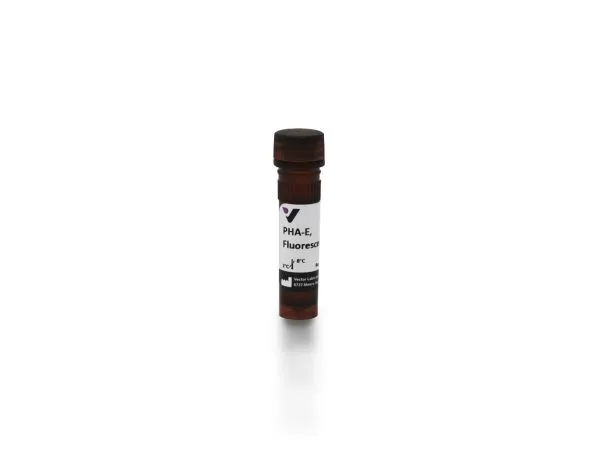
Phaseolus Vulgaris Erythroagglutinin (PHA-E), Fluorescein
Phaseolus vulgaris agglutinin is the name ascribed to a family of lectins, each of which consists of four subunits. There are two different types of subunits. One appears to be involved primarily in red cell agglutination and has been designated the “E” subunit (for erythroagglutinin). The other type is involved in lymphocyte agglutination and mitogenic activity and has been termed the “L” subunit (for leucoagglutinin). These subunits combine to produce five isolectins. PHA-E possesses strong hemagglutinating activity but is a poor mitogen.
Fluorescein labeled PHA-E has an appropriate number of fluorochromes bound to provide the optimum staining characteristics for this lectin. This conjugate is supplied essentially free of unconjugated fluorochromes. The excitation maximum is at 495 nm and the emission maximum is at 515 nm.
$184.00
| SKU | Unit Size | Price |
|---|---|---|
Select a unit size:
How do I request a quote or bulk pricing?
Technical Information Phaseolus vulgaris agglutinin is the name ascribed to a family of lectins, each of which consists of four subunits. There are two different types of subunits. One appears to be involved primarily in red cell agglutination and has been designated the E subunit (for erythroagglutinin). The other type is involved in lymphocyte agglutination and mitogenic activity and has been termed the L subunit (for leucoagglutinin). These subunits combine to produce five isolectins. One of these isolectins has four E subunits and is designated PHA-E. PHA-E possesses strong hemagglutinating activity but is a poor mitogen. PHA-L, with four L type subunits, does not agglutinate red cells but is a potent mitogen. The other three isolectins, designated E3L1, E2L2, and E1L3, have erythroagglutinating and mitogenic activities proportional to the number of respective E or L subunits. We have termed the mixture of the five isolectins PHA (E+L). PHA-L has been found to be an excellent, specific marker for use in anterograde neuronal tracing. Fluorescein labeled PHA-E has an appropriate number of fluorochromes bound to provide the optimum staining characteristics for this lectin. This conjugate is supplied essentially free of unconjugated fluorochromes. The excitation maximum is at 495 nm and the emission maximum is at 515 nm. Accompanying each fluorescent lectin is an analysis data sheet summarizing the results of our quality control tests and providing pertinent information on the product. All of these reagents are supplied as solutions preserved with sodium azide. Elution: 100 mM acetic acid |
 Powered by Bioz © 2023