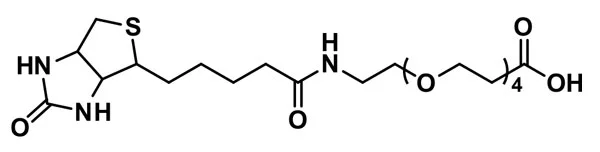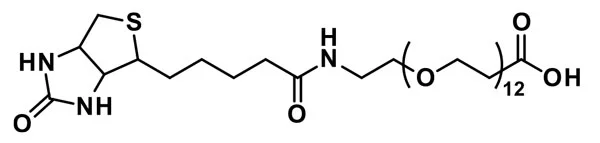
CAS Number 721431-18-1 | |
Molecular Weight 2500.99; single compound | |
Chemical Formula C₁₁₂H₂₁₈N₄O₅₃S | |
Purity > 98% | |
Unit Size 100mg, 1000mg | |
Solubility Methylene chloride, DMAC, DMSO or water. | |
Spacers dPEG® Spacer is 157 atoms and 187.8 Å | |
Storage Instructions -20°C; Always let come to room temperature before opening; be careful to limit exposure to moisture and restore under an inert atmosphere; stock solutions can be prepared with dry solvent and kept for several days (freeze when not in use). dPEG® pegylation compounds are generally hygroscopic and should be treated as such. This will be less noticeable with liquids, but the solids will become tacky and difficult to manipulate, if care is not taken to minimize air exposure. | |
Shipping Instructions Ambient |
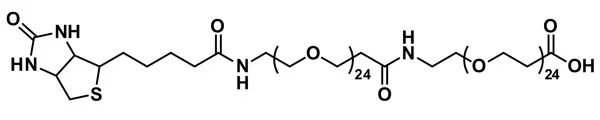
dPEG®₄₈-biotin acid
dPEG®48 biotin acid, product number QBD-10776, is a biotinylation reagent containing a long (157 atoms), single molecular weight, discrete polyethylene glycol (dPEG®) spacer that is functionalized with biotin on one end and a propionic acid moiety on the other. The terminal propionic acid group couples to amines directly using a carbodiimide such as EDC, and it can be functionalized as an N-hydroxysuccinimidyl (NHS) or 2,3,5,6-tetrafluorophenyl (TFP) ester for reaction with amines.
Amphiphilic dPEG®48 biotin acid is soluble in water, aqueous buffers, and organic solvents. When used as a label, it does not cause aggregation or precipitation of biomolecules even when excess label is used. Using 1-Ethyl-3-(3-dimethylaminopropyl)carbodiimide (EDC) chemistry, QBD-10776 can be coupled directly to free primary amines in aqueous media. These free amines can be on a protein, peptide, or the treated surface of a nanoparticle. The linker length of dPEG®48 biotin acid is longer than the linker length of LC-biotin and longer than the linker length of LC-LC-biotin. The performance characteristics of dPEG®48-biotin acid are quite superior to both LC-biotin and LC-LC-biotin.
Many applications use this product to take advantage of the strong avidin-biotin binding interaction. Such applications include single-cell imaging of protein secretion, developing biosensors, isolating specific cell types by separation with magnetic beads, characterizing and understanding the streptavidin-biotin interaction, creating affinity-based probes, and assembling supramolecular nanostructures.
Price range: $327.00 through $1,639.00
| SKU | Unit Size | Price |
|---|---|---|
Select a unit size:
How do I request a quote or bulk pricing?
Documents |