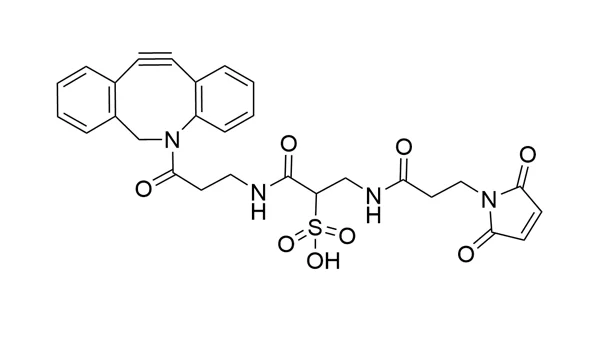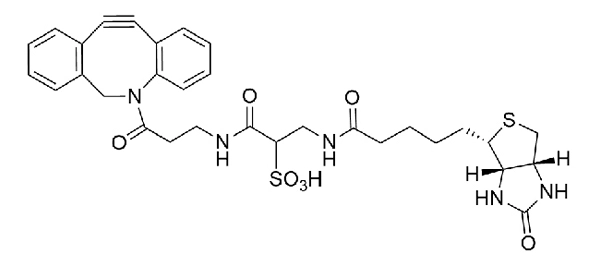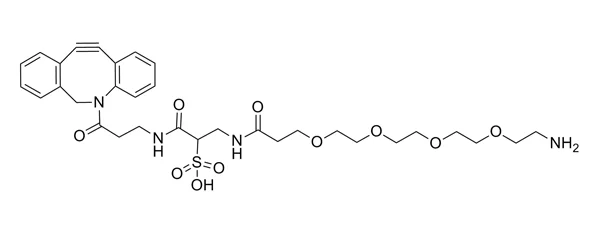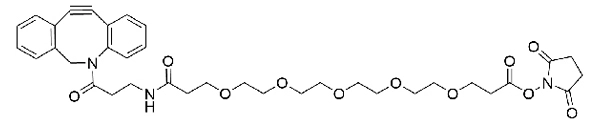
CAS Number N/A | |
Molecular Weight 319.35; single compound | |
Chemical Formula C₂₀H₁₇NO₃ | |
Purity > 98% | |
Unit Size 100 mg, 1000 mg | |
Solubility DMAC, DMSO, or DMF | |
Spacers N/A | |
Storage Instructions -20°C; Always let come to room temperature before opening; be careful to limit exposure to moisture and restore under an inert atmosphere; stock solutions can be prepared with dry solvent and kept for several days (freeze when not in use). dPEG® pegylation compounds are generally hygroscopic and should be treated as such. This will be less noticeable with liquids, but the solids will become tacky and difficult to manipulate, if care is not taken to minimize air exposure. | |
Shipping Instructions Ambient |
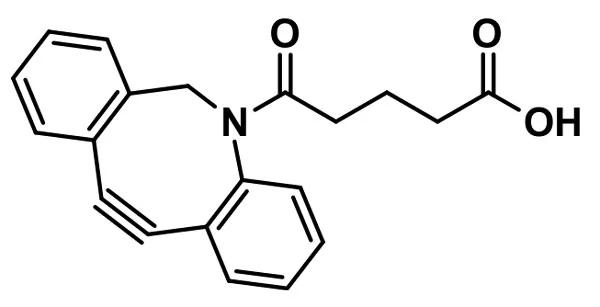
DBCO-acid
DBCO-acid, product number QBD-11814, is an aza-dibenzocyclooctyne (DBCO) product used for strain-promoted azide-alkyne cycloaddition (SPAAC, also known as “”copper free click chemistry””). The DBCO moiety reacts selectively with azides via SPAAC to form stable triazole linkages. Esterification of the terminal carboxylic acid with N-hydroxysuccinimide (NHS) or 2,3,5,6-tetrafluorophenol (TFP) allows for reaction with a primary amine. Insoluble in water, DBCO-acid is slightly soluble to sparingly soluble in most organic solvents. Vector Laboratories recommends dimethylsulfoxide (DMSO), N,N’-dimethylformamide (DMF), or N,N’-dimethylacetamide (DMAC) as solvents for this product. DBCO-acid is relatively insensitive to bases and can be used in the presence of aqueous bases. This product is acid sensitive and should not be subjected to pH <5 during reaction or workup.
The published discovery in 2004 of SPAAC, also known as “”copper free click chemistry,”” by Carolyn Bertozzi and coworkers improved the click chemistry toolbox. Toxic copper catalysts were eliminated, making the reaction truly bioorthogonal. By removing the copper(I) catalyst from the reaction, living cells can be labeled with reagents designed for SPAAC. Since the original publication, multiple improvements in strained cyclooctyne reagents resulted in the development of DBCO as a nearly perfect azide partner for SPAAC.
To use DBCO-acid in aqueous media or in cells, it should be conjugated to a water-soluble dPEG® product. Vector Laboratories offers numerous products for this purpose, including amino alcohols and amino acids. We also offer many DBCO-based dPEG® products already prepared for use.
Price range: $242.00 through $1,340.00
| SKU | Unit Size | Price |
|---|---|---|
Select a unit size:
How do I request a quote or bulk pricing?
Documents |