Molecular Weight 371.5 | |
Unit Size 50 mg | |
Species Carbohydrate, RNA | |
Storage Instructions 2-8 °C (desiccated). Once in solution, store frozen. | |
Tag/Group Incorporated Biotin | |
Safety Title WARNING: NA –www.P65Warnings.ca.gov | |
Source Species Carbohydrate, RNA |
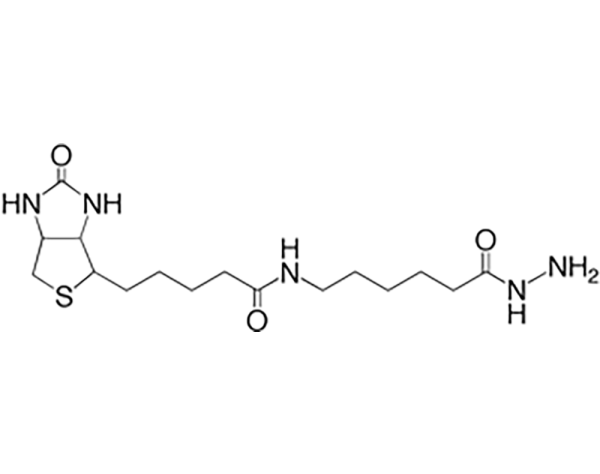
Biotin (Long Arm) Hydrazide
Biotin (Long Arm) Hydrazide (SP-1100) reacts with aldehyde groups and thus can be used to label carbohydrate groups present in a wide variety of macromolecules. The spacer arm in this product allows optimal accessibility of avidin or streptavidin conjugates to biotin.
Features:
• Can be incorporated into RNA at the 3′ end (after oxydation or 3′ ribose)
$161.00
| SKU | Unit Size | Price |
|---|---|---|
Select a unit size:
How do I request a quote or bulk pricing?
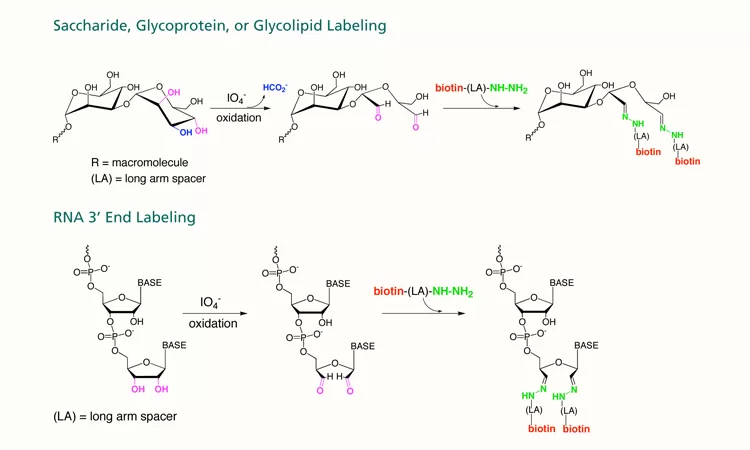
Technical Information Polysaccharides, glycoproteins, or glycolipidsBiotin can be incorporated into viruses, bacteria, or animal and plant cells via their surface carbohydrate groups. Incorporation of Biotin (Long Arm) Hydrazide occurs onto sugars containing unsubstituted vicinal hydroxyl groups that are usually present at the non-reducing termini of the oligosaccharide. Coupling of biotin is accomplished in two steps:
RNA 3’End LabelingRNA can be specifically labeled with biotin at the 3′ end. The two-step procedure involves:
Proteins and other moleculesThis reagent can also be used to couple biotin to carboxyl groups on proteins and other molecules using a carbodiimide coupling method. Other materialsInitial activation of a material such as plastics with glutaraldehyde allows subsequent incorporation of Biotin (Long Arm) Hydrazide onto the surface.
|
 Powered by Bioz © 2023