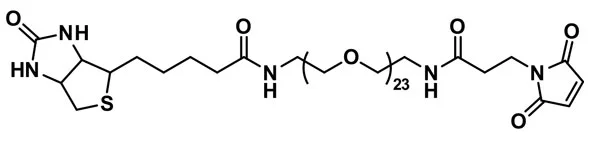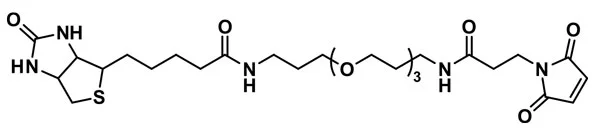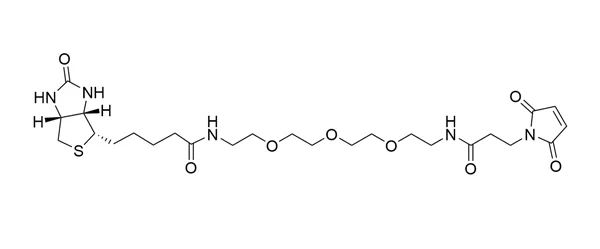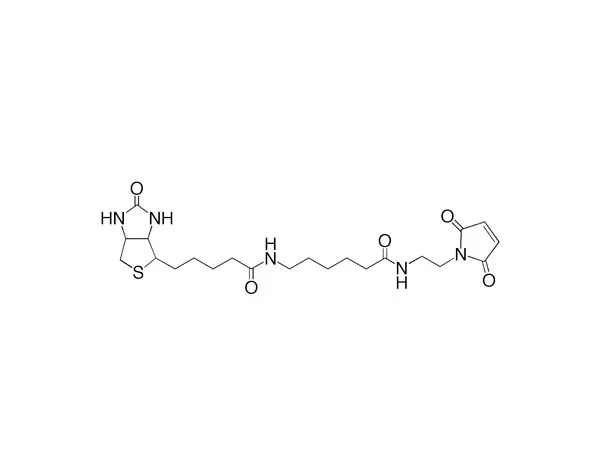
CAS Number 1334172-60-9 | |
Molecular Weight 922.09; single compound | |
Chemical Formula C₄₁H₇₁N₅O₁₆S | |
Purity > 98% | |
Unit Size 25 mg, 100 mg | |
Solubility Methylene chloride, DMAC or DMSO. | |
Spacers dPEG® Spacer is 43 atoms and 50.5 Å | |
Storage Instructions -20°C; Always let come to room temperature before opening; be careful to limit exposure to moisture and restore under an inert atmosphere; stock solutions can be prepared with dry solvent and kept for several days (freeze when not in use). dPEG® pegylation compounds are generally hygroscopic and should be treated as such. This will be less noticeable with liquids, but the solids will become tacky and difficult to manipulate, if care is not taken to minimize air exposure. | |
Shipping Instructions Ambient |
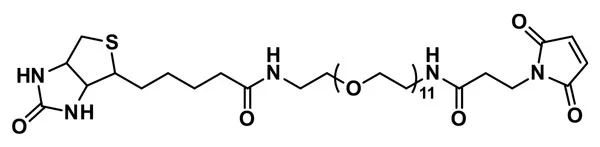
Biotin-dPEG®₁₁-MAL
Biotin-dPEG®11-MAL, product number QBD-10195, is one of three products containing a biotin on one end of a dPEG® linker and a maleimidopropyl moiety on the other end. The maleimide group is a useful, highly popular reactive group for conjugating to free thiol groups in biomolecules. This product provides a short-chain, single molecular weight, discrete PEG (dPEG®) spacer between the biotin and the maleimide. Maleimide groups can be conjugated to free thiol groups in the pH range from 6.5 – 7.5, forming a stable thioether linkage. The dPEG® spacer in this product increases the hydrophilicity of the conjugate.
This product has proven useful in a variety of applications that take advantage of the high streptavidin-biotin binding affinity. Such applications include magnetic bead-based assays, assays to quantitate reducible thiols in proteins, atomic force microscopy, and nanoparticle applications, among others.
To use Biotin-dPEG®11-MAL, the product should be dissolved in dry solvent and then added to an aqueous solution of the compound containing the free thiol. The water-miscible solvent N,N’-dimethylacetamide (DMAC) dried over 3Å molecular sieves is an excellent solvent to use for this purpose. For biomolecules (e.g., antibodies), care should be taken to keep the amount of organic solvent to a minimum so as not to denature the biomolecule or cause salt precipitation.
Price range: $241.00 through $492.00
| SKU | Unit Size | Price |
|---|---|---|
Select a unit size:
How do I request a quote or bulk pricing?
Documents |