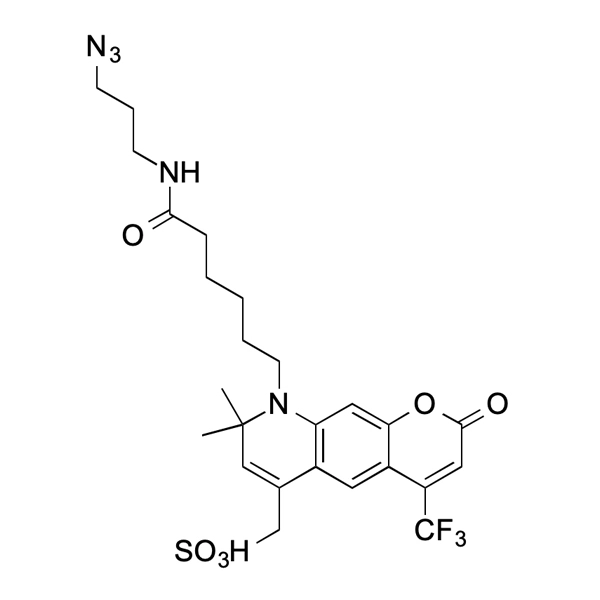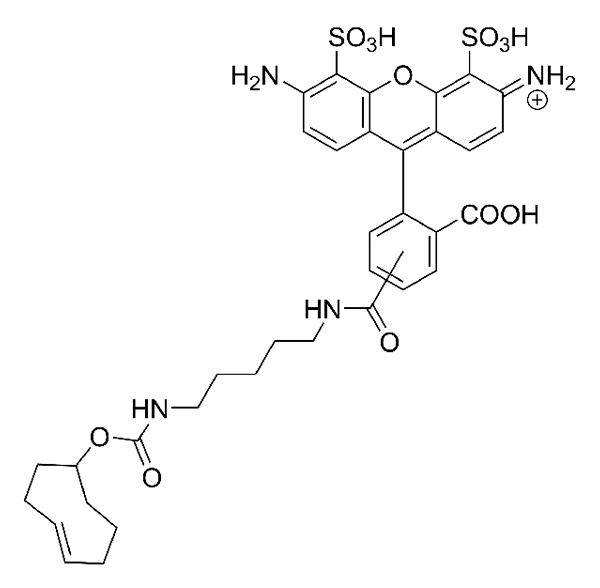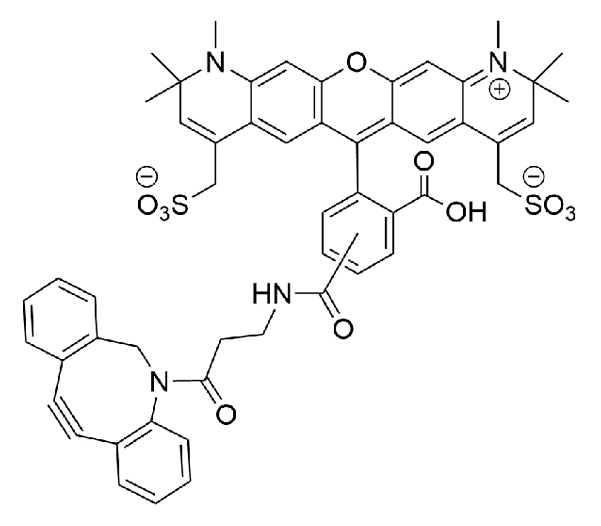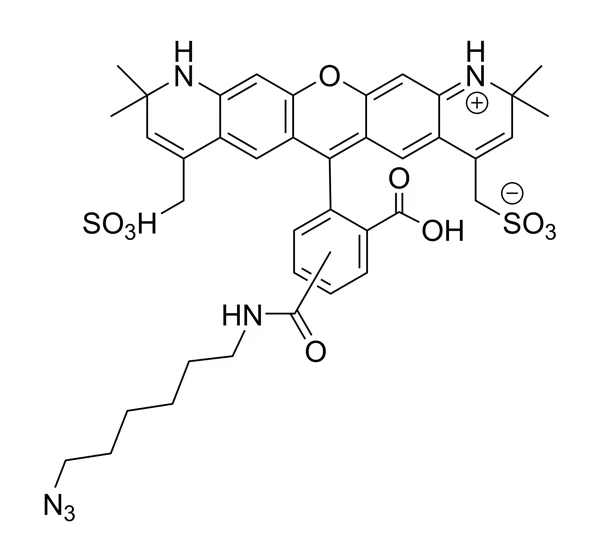
CAS Number N/A | |
Molecular Weight 1145.45 | |
Molecular Formula C56H80N12O10S2 | |
Appearance Red solid | |
Chemical Formula C56H80N12O10S2 | |
Extinction Coefficient 88,000 | |
Purity >95% (HPLC) | |
Unit Size 1 mg, 5 mg, 25 mg | |
Solubility Water, DMSO, DMF | |
Storage Instructions -20°C. Desiccate | |
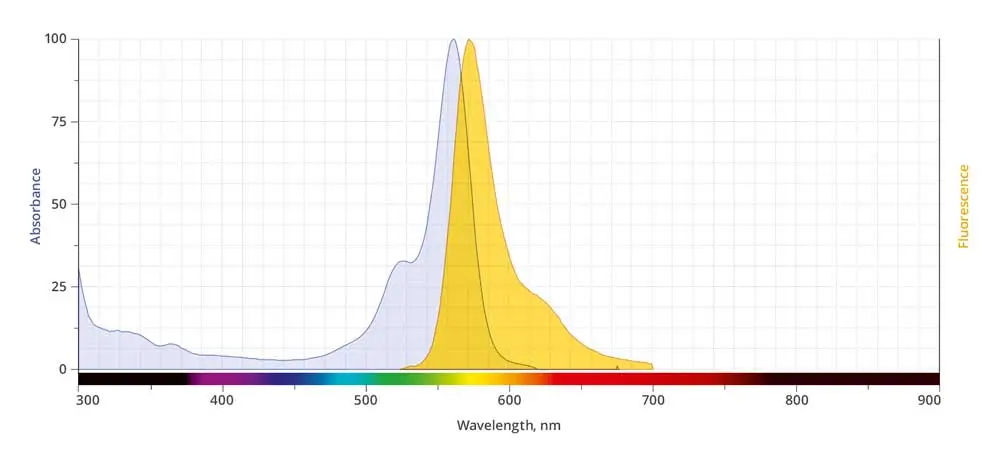
Spectrally Similar Dyes Alexa Fluor® 594, CF® 594, DyLight® 594 | |
Laser Line 561 nm or 594 nm | |
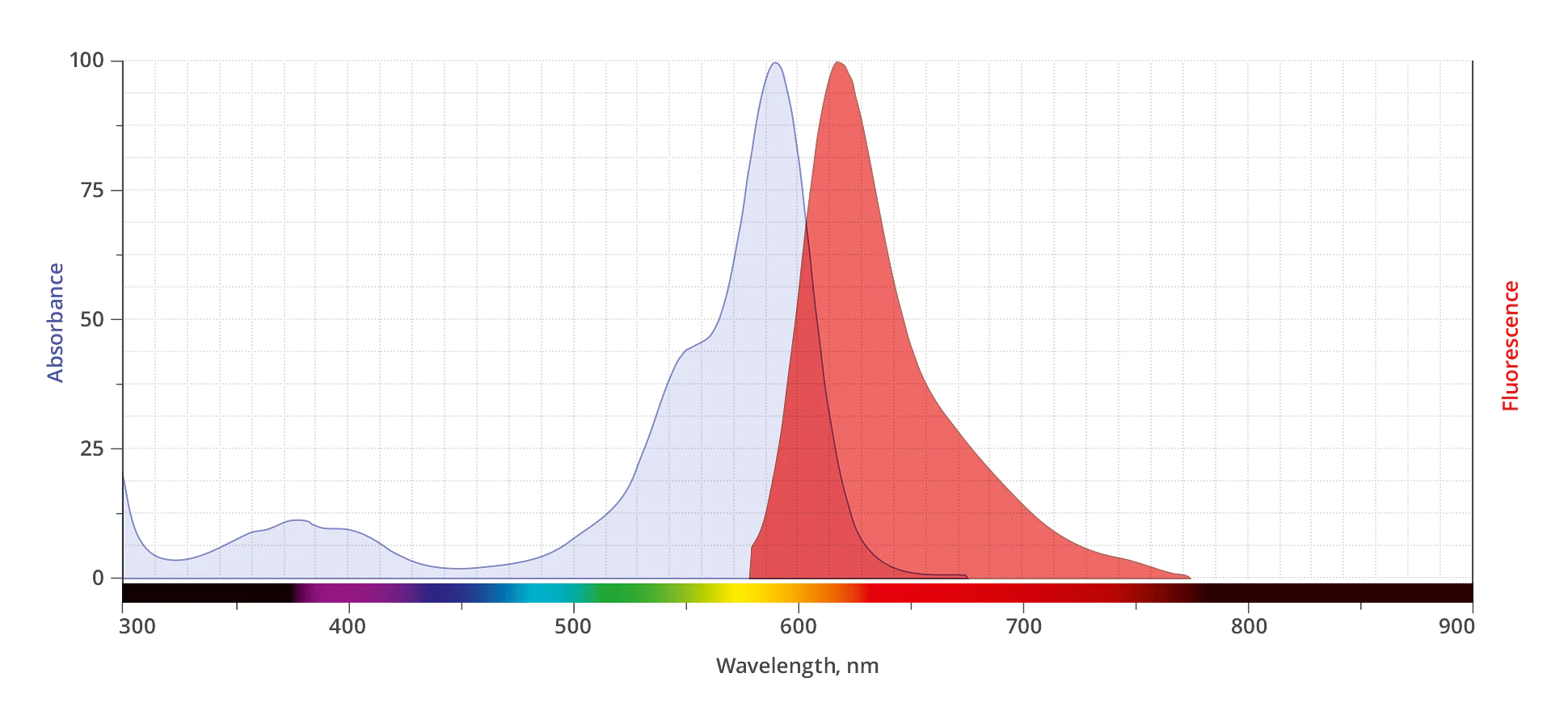
Excitation/Emission Maximum 590 nm / 617 nm | |
Shipping Conditions Ambient temperature | |
Shipping Instructions Ambient temperature |
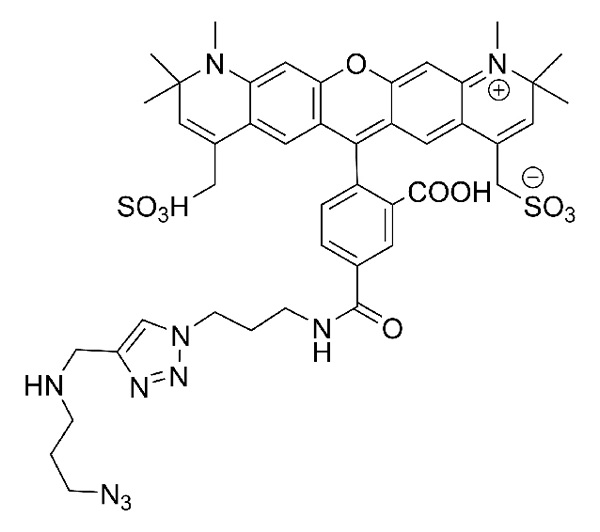
AZDye 594 Azide Plus
Azide Plus reagents is the most recent step in improving CuAAC reaction in complex media developed by scientists at Click Chemistry Tools. Azide Plus reagents contain a complete copper-chelating system in their structure, allowing for the formation of strong, active copper complexes that act simultaneously as both reactant and catalyst in the CuAAC reaction. This azide-copper complex reacts almost instantaneously with alkynes under diluted conditions. This unprecedented reactivity in the CuAAC reaction is of special value for the detection of low abundance targets, improving biocompatibility, and is also valuable for any other application where greatly improved S/N ratio is highly desired.
Price range: $215.00 through $2,022.00
| SKU | Unit Size | Price |
|---|---|---|
Select a unit size:
How do I request a quote or bulk pricing?
Abs/Em Spectra
|
Click Reaction Protocol Click Reaction Protocol for Staining Fixed/Permeabilized CellThis is a general protocol for fixed/permeabilized cell imaging through a copper-catalyzed click reaction using the fluorescent Azide Plus reagent. We recommend using this protocol as a starting point for optimization of particular click chemistry procedures. We have found that a 1.5-3.0 μM concentration of Azide Plus reagent was optimal for most applications, including imaging of EdU incorporated into newly synthesized DNA and imaging of OPP labeled proteins without causing a high background signal. The optimal final concentration of the Azide Plus reagent is sample dependent and may range from 0.5 μM to 10 μM. Final concentrations below or above this range are also possible, and should be optimized per the specific application.
Click Reaction Protocol for Cell Lysates LabelingThis is a general protocol for labeling proteins in cell lysate through a copper-catalyzed click reaction using the fluorescent Azide Plus reagent. We recommend using this protocol as a starting point for optimization of particular click chemistry procedures. We have found that a 20 μM concentration of Azide Plus reagent was sufficient to label all alkyne-tagged proteins in the cell lysate without causing a high background signal. The optimal final concentration of the Azide Plus reagent is sample dependent and may range from 5 μM to 50 μM. Final concentrations below or above this range are also possible, and should be optimized per the specific application.
| |||||||||||||||||||||||||||||||||||
Documents |