CAS Number N/A | |
Molecular Weight 4490.37; single compound; | |
Chemical Formula C₂₀₅H₄₀₃N₅O₉₇ | |
Purity > 95% | |
Unit Size 25 mg, 100 mg | |
Solubility Methylene Chloride, DMSO, DMAC, DMF or Methanol. | |
Spacers dPEG® Spacer is 126 atoms and 102.8 Å, avg. | |
Storage Instructions -20°C; Always let come to room temperature before opening; be careful to limit exposure to moisture and restore under an inert atmosphere; stock solutions can be prepared with dry solvent and kept for several days (freeze when not in use). dPEG® pegylation compounds are generally hygroscopic and should be treated as such. This will be less noticeable with liquids, but the solids will become tacky and difficult to manipulate, if care is not taken to minimize air exposure. | |
Shipping Instructions Ambient |
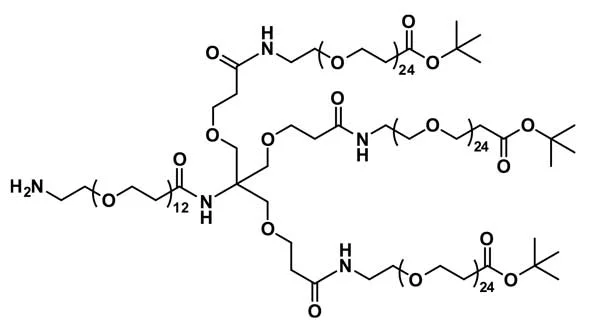
Amino-dPEG®₁₂-Tris(-dPEG®₂₄-t-butyl ester)₃
Amino-dPEG®12-Tris(dPEG®24-t-butyl ester)3, product number QBD-11449, is a branched, four-arm, single molecular weight, discrete-length polyethylene glycol (dPEG®) product. Built around a tris core, the product consists of a carboxylate-reactive, medium-length (40 atoms) amino-dPEG®12 tail joined to one side of the tris core and three, equally long (76 atoms) tert-butyl-ester-protected dPEG®24 branches. The total length from the terminal, carboxylate-reactive amine tail to the carbonyl carbons on the branches is 126 atoms (102.8 Å, average).
Amino-dPEG®12-Tris(dPEG®24-t-butyl ester)3 increases the hydrodynamic volume and water solubility of conjugates made with it. The increased hydrodynamic volume protects conjugates from renal clearance and can shield them from the immune system.
The tert-butyl-ester-protected dPEG®24 branches can be deprotected with trifluoroacetic or formic acid. Once deprotected, the free carboxylic acids can be used for charge modification of the conjugate molecule or further functionalized for additional reactions. In addition to conjugate charge modification, potential uses for this product include PK/BD optimization of biomolecules, surface coating and passivation to prevent non-specific interactions, dendrimer construction, and payload delivery (cytotoxins, targeting molecules, etc.).
Price range: $372.00 through $916.00
| SKU | Unit Size | Price |
|---|---|---|
Select a unit size:
How do I request a quote or bulk pricing?
Documents |