CAS Number N/A | |
Molecular Weight 1563.11 | |
Molecular Formula C83H115N7O14S4 | |
Appearance Dark green solid | |
Chemical Formula C83H115N7O14S4 | |
Extinction Coefficient 255,000 | |
Purity >95% (HPLC) | |
Unit Size 1 mg, 5 mg, 25 mg, 100 mg | |
Solubility Water, DMSO, DMF | |
Storage Instructions -20°C. Desiccate | |
Spectrally Similar Dyes Alexa Fluor® 750, RDye® 750, CF® 750 Dye, DyLight® 750 | |
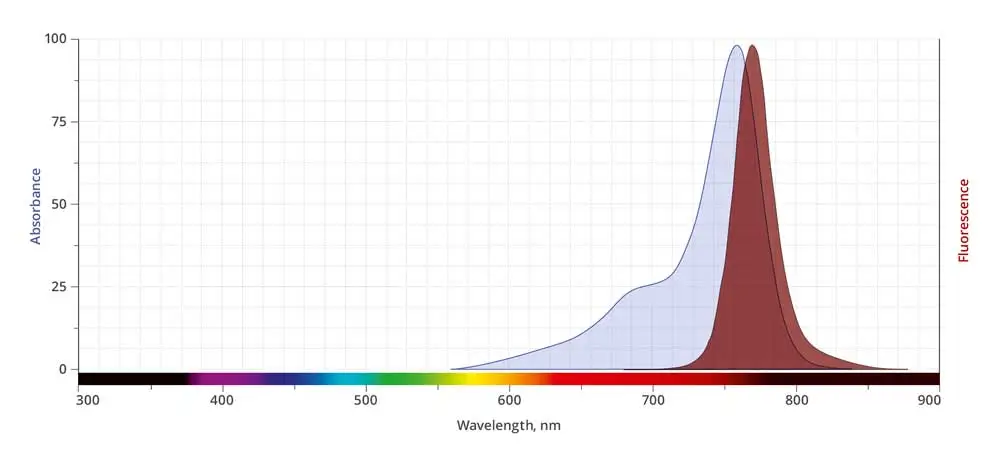
Excitation/Emission Maximum 759 nm / 775 nm | |
Shipping Conditions Ambient temperature | |
Shipping Instructions Ambient temperature |
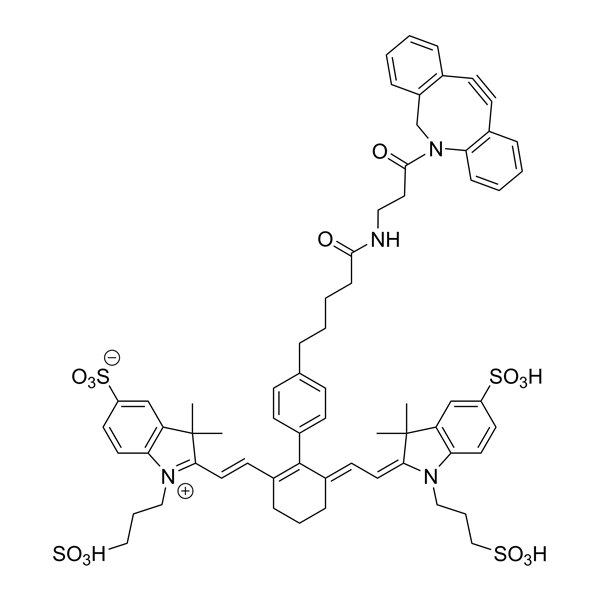
Cy7 DBCO
Cy7 DBCO is a bright and photostable near-IR probe that spectrally similar to Alexa Fluor® 750, DyLight® 750, and IRDye® 750 dye. The Cy7 DBCO is water-soluble, hydrophilic dye often a reagent of choice for assay where minimal non-specific binding and exceptional brightness is required. The fluorescence of Cy7 DBCO is pH insensitive from pH 4 to pH 10 and produces minimal autofluorescence of biological specimens in this region of the spectrum. Fluorescence of this long-wavelength Cyanine dye is not visible to the human eye but is readily detected by most imaging systems.
Cy7 DBCO reacts with azides via a copper-free “click chemistry” reaction to form a stable triazole and does not require Cu-catalyst or elevated temperatures. In application where the presence of copper is a concern Cy7 DBCO is an ideal alternative to copper requiring fluorescent alkynes.
Cy7 DBCO reagent is not suitable for staining intracellular components of fixed and permeabilized cells due to high backgrounds.
Price range: $149.00 through $3,490.00
| SKU | Unit Size | Price |
|---|---|---|
Select a unit size:
How do I request a quote or bulk pricing?
Abs/Em Spectra
|
Selected References
|