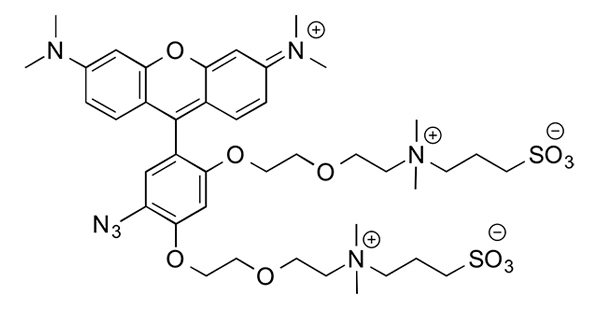
CAS Number N/A | |
Molecular Weight 878.1 | |
Appearance Dark red amorphous solid | |
Purity >90% (HPLC) | |
Unit Size 1 mg, 5 mg | |
Solubility Water, DMSO | |
Storage Instructions -20°C. Desiccate | |
Spectrally Similar Dyes Alexa Fluor® 594, CF® 594, DyLight® 594, Texas Red | |
Excitation/Emission Maximum 591/609 nm | |
Shipping Conditions Ambient temperature | |
Shipping Instructions Ambient temperature |
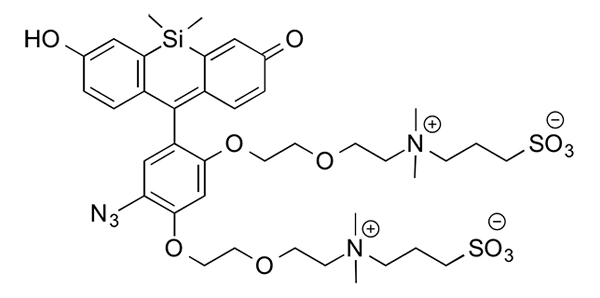
CalFluor 580 Azide
A major shortcoming of the visualization of alkyne-tagged biomolecules with fluorescent azide probes through CuAAC is the need to remove unreacted fluorescent probes. This is particularly problematic when imaging the intracellular environment, tissues of living organisms, or visualizing biomolecules in vivo. Failure to remove all unreacted fluorescent probes is also one of the major contributors to background signal and non-specific binding.
To overcome this shortcoming, Carolyn Bertozzi’s group has designed fluorogenic azide probes that are activated by Cu-catalyzed or metal-free click chemistry. These azide probes are not fluorescent until they react with alkynes. Termed the CalFluors, these probes possess emission maxima that range from green to far-red wavelengths, and enable sensitive biomolecule detection under no-wash conditions. A number of reports show that CalFluor probes are an indispensable tool for sensitive visualization of metabolically labeled molecules (glycans, DNA, RNA, and proteins) in cells, developing zebrafish, and mouse brain tissue slices under no-wash conditions.
Price range: $308.00 through $1,368.00
| SKU | Unit Size | Price |
|---|---|---|
Select a unit size:
How do I request a quote or bulk pricing?
Disclaimer CalFluor Azide Probes are covered by U.S. Patent No.: 9,410,958.This product may be used for research purposes only. It is not licensed for resale and may only be used by the buyer. This product may not be used and is not licensed for clinical assays, where the results of such assays are provided as a diagnostic service. If a diagnostic or therapeutic use is anticipated, then a license must be requested from the University of California. The availability of such diagnostic and therapeutic use license(s) cannot be guaranteed from the University of California. |
Selected References |