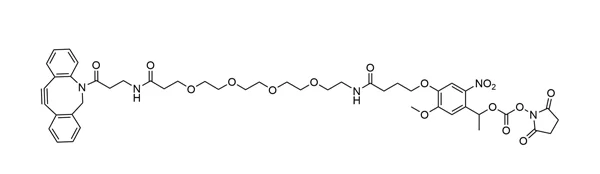
CAS Number 1008402-79-6 | |
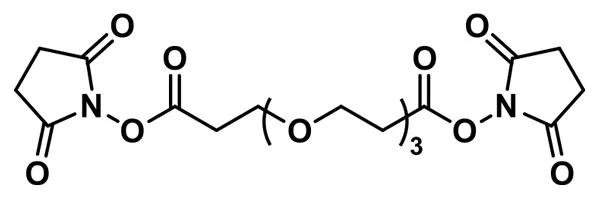
Molecular Weight 708.71; single compound | |
Chemical Formula C₃₀H₄₈N₂O₁₇ | |
Purity > 97% | |
Unit Size 100 mg, 1000 mg | |
Solubility Methylene chloride, Acetonitrile, DMAC or DMSO. | |
Spacers dPEG® Spacer is 31 atoms and 35.7 Å | |
Storage Instructions -20°C; Always let come to room temperature before opening; be careful to limit exposure to moisture and restore under an inert atmosphere; stock solutions can be prepared with dry solvent and kept for several days (freeze when not in use). dPEG® pegylation compounds are generally hygroscopic and should be treated as such. This will be less noticeable with liquids, but the solids will become tacky and difficult to manipulate, if care is not taken to minimize air exposure. | |
Shipping Instructions Ambient |
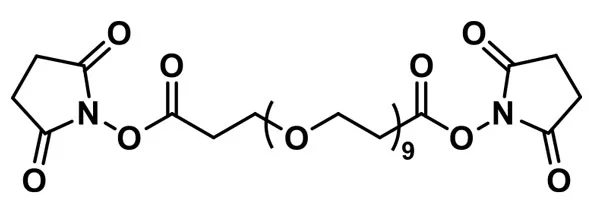
Bis-dPEG®₉-NHS ester
Bis-dPEG®9-NHS ester, product number QBD-10246, is a homobifunctional, amine-reactive, single molecular weight PEG crosslinker with a medium-length (31 atoms, 35.7 Å), discrete PEG (dPEG®) chain length. Each end of the chain terminates as the N-hydroxysuccinimidyl (NHS) ester of propionic acid. Several scientific publications describe the use of QBD-10246.
NHS esters react with free amines such as the ε-amines of lysine with an optimal pH range of 7.0 – 7.5. However, NHS esters can react with free amines with pH as low as 6.0. NHS esters are susceptible to hydrolysis in aqueous media. The hydrolysis rate of the ester increases with the pH.
Thus, we strongly discourage storing Bis-dPEG®9-NHS ester in water or aqueous buffer. Instead, we recommend that customers make new solutions of the product as needed, use them immediately, and discard unused solutions after use. If customers desire to store the product in solution, we recommend the use of a pure, anhydrous, water-miscible solvent such as dimethyl sulfoxide (DMSO), N,N-dimethylacetamide (DMAC), or N,N-dimethylformamide (DMF). DMSO, DMAC, or DMF can be dried chemically or by storing for a minimum of 24 hours over 3 Å molecular sieves. With DMF, use only fresh solvent as the compound decomposes over time to form free amines that will react with the NHS esters.
Price range: $246.00 through $602.00
| SKU | Unit Size | Price |
|---|---|---|
Select a unit size:
How do I request a quote or bulk pricing?
Documents |