CAS Number 854753-78-9 | |
Molecular Weight 846.92; single compound | |
Chemical Formula C₃₈H₆₂N₄O₁₇ | |
Purity > 98% | |
Unit Size 50 mg, 1000 mg | |
Solubility Methylene chloride, DMAC or DMSO. | |
Spacers dPEG® Spacer is 49 atoms and 56.0 Å | |
Storage Instructions -20°C; Always let come to room temperature before opening; be careful to limit exposure to moisture and restore under an inert atmosphere; stock solutions can be prepared with dry solvent and kept for several days (freeze when not in use). dPEG® pegylation compounds are generally hygroscopic and should be treated as such. This will be less noticeable with liquids, but the solids will become tacky and difficult to manipulate, if care is not taken to minimize air exposure. | |
Shipping Instructions Ambient |
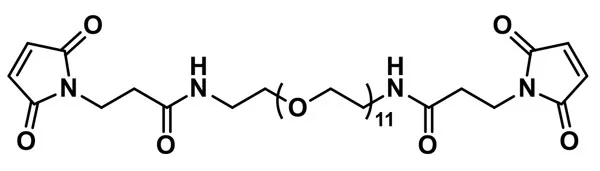
Bis-MAL-dPEG®₁₁
Bis-MAL-dPEG®11, product number 10397, is a medium-length, homobifunctional, crosslinking reagent that links two molecules (e.g., peptides, proteins) together via the thiol-maleimide reaction (also known as the thiol-Michael addition). The ends of the molecule are both functionalized with maleimidopropionate groups. The two reactive ends are separated by a single molecular weight, discrete polyethylene glycol (dPEG®) spacer. The thiol-maleimide reaction, a type of click chemistry reaction, is an extremely popular way to conjugate molecules. The maleimide functional group rapidly reacts with sulfhydryl groups, and the reaction is chemoselective for sulfhydryls in the pH range of 6.5 – 7.5. The polyethylene glycol (PEG) spacer between the two maleimide groups is a single molecular weight compound with a discrete chain length (thus the tradename dPEG®). This product is not made from a disperse polymer but is instead a single compound. Applications for this product include, among many others, studying cell internalization of crosslinked proteins; developing FRET immunoassays; and anchoring biomolecules to surfaces.
- Miyamoto T, Lillehoj HS, Sohn EJ, Min W. Production and characterization of monoclonal antibodies detecting chicken interleukin-2 and the development of an antigen capture enzyme-linked immunosorbent assay. Vet Immunol Immunopathol. 2001;80(3-4):245-257. doi:10.1016/s0165-2427(01)00273-2.
- Lee SH, Lillehoj HS, Jang SI, Baldwin C, Tompkins D, Wagner B, Parcells M, Del Cacho E, Hong YH, Min W, Lillehoj EP. Development and characterization of mouse monoclonal antibodies reactive with chicken interleukin-2 receptor αlpha chain (CD25). Vet Immunol Immunopathol. 2011 Dec 15;144(3-4):396-404. doi: 10.1016/j.vetimm.2011.08.001. Epub 2011 Aug 9. PMID: 21872344.
If you publish research with this product, please let us know so we can cite your paper.
These mouse IgG1 monoclonal antibodies were generated against recombinant chicken Interleukin-2 (IL-2) and recognize chicken IL-2.
Highlights:
- Reacts with chicken IL-2
- May be useful for future investigation of chicken regulatory T cells
- Suitable for Western Blot and ELISA (clones 4, 8 & 16)
- Clones 3B8, 4E9, 11C3, 8H8 & 14H9 also used in Flow Cytometry (Vet Immunol Immunopathol. 2011 Dec 15;144(3-4):396-404.) applications
Interleukin-2 (IL-2) is a powerful growth factor in a variety of cell types and plays key roles in T cell differentiation and function, B cell development, and NK cell activation. This cytokine is part of the body's natural response to microbial infection, and in distinguishing between foreign ("non-self") and "self". IL-2 mediates its effects by binding to IL-2 receptors, which are expressed by lymphocytes. It has been shown to be involved in itchy psoriasis.
From the laboratory of United States Department of Agriculture/USDA
C22H26N2O3
Price range: $241.00 through $1,311.00
| SKU | Unit Size | Price |
|---|---|---|
Select a unit size:
How do I request a quote or bulk pricing?
Documents |