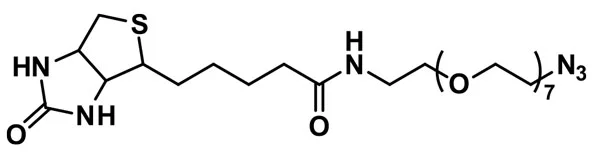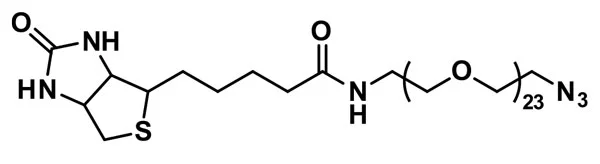
CAS Number 956494-20-5 | |
Molecular Weight 796.97; single compound | |
Chemical Formula C₃₄H₆₄N₆O₁₃S | |
Purity > 98% | |
Unit Size 100mg, 1000mg | |
Solubility Methylene chloride, DMAC or DMSO. | |
Spacers dPEG® Spacer is 40 atoms and 50.4 Å | |
Storage Instructions -20°C; Always let come to room temperature before opening; be careful to limit exposure to moisture and restore under an inert atmosphere; stock solutions can be prepared with dry solvent and kept for several days (freeze when not in use). dPEG® pegylation compounds are generally hygroscopic and should be treated as such. This will be less noticeable with liquids, but the solids will become tacky and difficult to manipulate, if care is not taken to minimize air exposure. | |
Shipping Instructions Ambient |
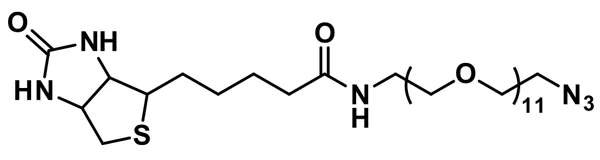
Biotin-dPEG®₁₁-azide
Biotin-dPEG®11-azide, product number QBD-10784, is a water-soluble biotinylation product functionalized with azide for click chemistry use, on a medium-length (40 atoms) single molecular weight, discrete PEG (dPEG®) chain. This product enables biotinylation of molecules using either metal-catalyzed (CuAAC, RuAAC) or strain-promoted azide-alkyne cycloaddition (SPAAC) chemistry. Consequently, these products allow new types of biotinylated constructs.
Because Biotin-dPEG®11-azide is a single molecular weight dPEG® product, analysis of the resulting conjugates is simplified. The researcher using this product does not have to analyze a variety of PEG chain lengths and molecular weights. Instead, the well-defined dPEG® product will yield predictable, identifiable conjugates. When using Biotin-dPEG®11-azide with proteins or peptides engineered to contain alkyne side chains at specific locations, both the number and location of conjugation sites are predictable.
As a biotinylation reagent, Biotin-dPEG®11-azide works in various applications. Pull-down assays, affinity purification, plate-type assays such as ELISA, and supramolecular construction can all incorporate Biotin-dPEG®11-azide. For instance, in a novel use of QBD-10784, Biotin-dPEG®11-azide was employed in a pull-down assay to identify electrophiles in signaling pathways in the worm Caenorhabditis elegans.
Price range: $273.00 through $1,529.00
| SKU | Unit Size | Price |
|---|---|---|
Select a unit size:
How do I request a quote or bulk pricing?
Documents |