CAS Number 1334178-03-8 | |
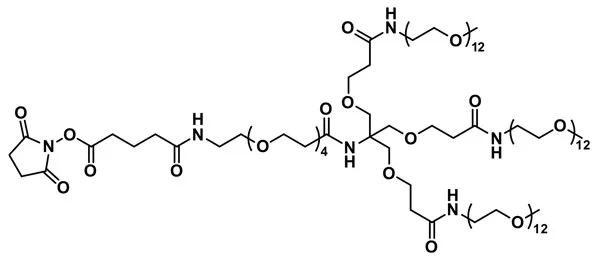
Molecular Weight 2420.80; single compound | |
Chemical Formula C₁₀₈H₂₀₆N₆O₅₂ | |
Purity > 96% | |
Unit Size 100 mg, 1000 mg | |
Solubility Methylene chloride, DMAC, DMSO or Acetonitrile. | |
Spacers dPEG® Spacer is 66 atoms and 51.1 Å, avg. | |
Storage Instructions -20°C; Always let come to room temperature before opening; be careful to limit exposure to moisture and restore under an inert atmosphere; stock solutions can be prepared with dry solvent and kept for several days (freeze when not in use). dPEG® pegylation compounds are generally hygroscopic and should be treated as such. This will be less noticeable with liquids, but the solids will become tacky and difficult to manipulate, if care is not taken to minimize air exposure. | |
Shipping Instructions Ambient |
NHS-dPEG®₄-(m-dPEG®₁₂)₃-ester
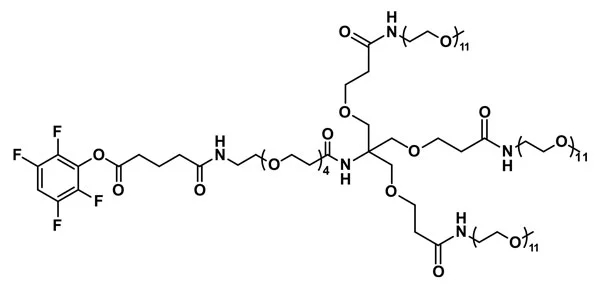
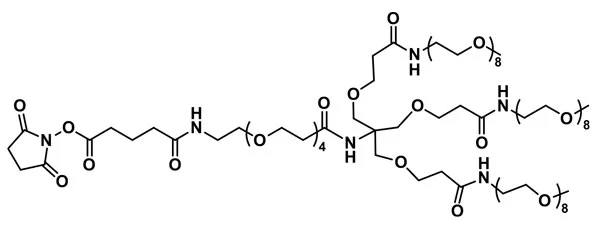
NHS-dPEG®4-(m-dPEG®12)3 ester, product number QBD-10401, is a water-soluble, amine-reactive, single molecular weight, branched PEGylation reagent built around a tris core and used to modify amine-functionalized surfaces and biomolecules. Three equal-length dPEG®12 branches terminate with methyl groups. A short dPEG®4 arm ends with an amine-reactive N-hydroxysuccinimidyl (NHS) ester. From the terminal carbonyl carbon of the dPEG®4 arm to each terminal methyl group on the dPEG®12 branches, the distance is 66 atoms (51.1 Å) long. This hydrophilic branched dPEG® product adds hydrodynamic volume to the conjugates, which reduces immunogenicity and renal clearance. Moreover, this product reduces or eliminates non-specific binding to conjugates and surfaces.
The reaction chemistry for coupling a free amine to an NHS ester is standard in almost all bioconjugation labs worldwide. Numerous scientific publications attest to the benefits of NHS-dPEG®4-(m-dPEG®12)3 ester. These reports describe this product being used to:
Coat nanoparticle surfaces;
Create imaging applications;
Develop Antibody-Drug Conjugates (ADCs);
Modify PK and BD of biomolecular conjugates;
Prevent non-specific binding;
Passivate inorganic surfaces such as metal and diamond; and,
Develop hemerythrin-based blood substitutes.
Price range: $273.00 through $1,420.00
| SKU | Unit Size | Price |
|---|---|---|
Select a unit size:
How do I request a quote or bulk pricing?
Documents |