Molecular Weight 50 | |
Color of Fluorescence Green | |
Extinction Coefficient 1.9 | |
Formulation 10 mM HEPES, 0.15 M NaCl, pH 7.5, 0.08% sodium azide, 0.1 mM CaCl2 | |
Inhibiting or Eluting Sugar a-methyl-mannoside | |
Maximum Emission 514-521 nm | |
Maximum Excitation 495-500 nm | |
Unit Size 2 mg | |
Storage Instructions 2-8°C | |
Sugar Specificity Terminal Manα1−6 and terminal Manα1−3 | |
Usage Summary The recommended concentration range for use is 5-20 µg/ml. | |
Applications Immunofluorescence, Glycobiology | |
Concentration 2 mg active conjugate/ml | |
Conjugate Fluorescein |
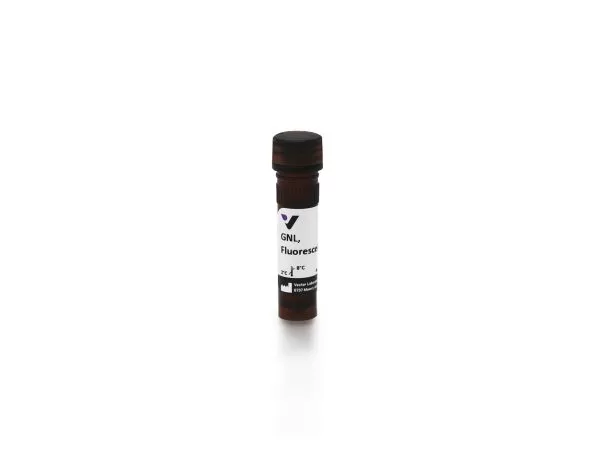
Galanthus Nivalis Lectin (GNL), Fluorescein
Galanthus nivalis lectin, unlike most mannose-specific lectins, is not a metalloprotein and does not require Ca++ or Mn++ for binding.
Binding seems to be preferentially directed toward structures containing (α-1,3) mannose residues. Also in contrast to most mannose-binding lectins, GNL will not bind α-linked glucose. Reports indicate that this lectin binds rat and mouse IgM but not IgG. The only protein from human serum reported to bind to this lectin is α2-macroglobulin. GNL binds to many viral glycoproteins.
Fluorescein labeled Galanthus nivalis lectin has an appropriate number of fluorochromes bound to provide the optimum staining characteristics for this lectin. This conjugate is supplied essentially free of unconjugated fluorochromes. The excitation maximum is at 495 nm and the emission maximum is at 515 nm.
$179.00
| SKU | Unit Size | Price |
|---|---|---|
Select a unit size:
How do I request a quote or bulk pricing?
Technical Information Accompanying each fluorescent lectin is an analysis data sheet summarizing the results of our quality control tests and providing pertinent information on the product. All of these reagents are supplied as solutions preserved with sodium azide. Inhibiting/Eluting Sugar: 100 mM – 200 mM α-methylmannoside |
 Powered by Bioz © 2023