Detection Enzyme Peroxidase | |
Format Concentrate | |
Formulation 50 mM HEPES, 100 mM Na2SO4, pH 6.8, preservative. | |
Isolation Technology Micropolymer Reagents | |
Unit Size 0.8 ml | |
Storage Instructions 2-8 °C, DO NOT FREEZE | |
Usage Summary Suggested working dilution range: Chromogenic substrates: 1:500-1:5000 Chemiluminescent substrates: 1:5,000-1:200,000 | |
Applications Blotting Applications, Elispot | |
Target Species Rabbit | |
Concentration 5.0 mg/ml conjugate | |
Conjugate Micropolymer HRP | |
Platform Micropolymer Reagents |
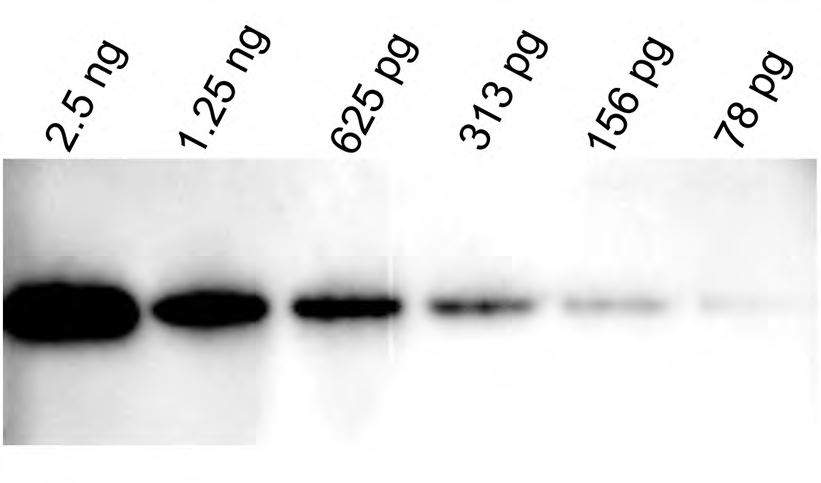
WestVision Peroxidase Polymer, Anti-Rabbit IgG (Western Blot Detection)
Highly active WestVision™ Peroxidase Polymer antibody conjugates have been added to our line of western blot detection reagents. These reagents are:
• Sensitive
• Convenient
• EconomicalWestVision™ Peroxidase Polymer antibody conjugates bind primary antibodies of mouse (WB-2000) or rabbit (WB-1000) origin with high affinity, producing sharp signal and low background in western blot detection. The conjugates are based on a new method of polymerizing enzymes and attaching these polymers to antibodies. The novel approach employed to form enzyme polymers avoids the use of large dextrans or other macromolecules as a backbone. Attaching these unique polymers to an antibody allows a higher density of enzymes to access a target with minimal interference. The result is an excellent signal-to-noise- ratio in western blot detection.
$293.00
| SKU | Unit Size | Price |
|---|---|---|
Select a unit size:
How do I request a quote or bulk pricing?
Technical Information Highly active WestVision™ Peroxidase Polymer antibody conjugates have been added to our line of western blot detection reagents. These reagents are:
WestVision™ Peroxidase Polymer antibody conjugates bind primary antibodies of mouse (WB-2000) or rabbit (WB-1000) origin with high affinity, producing sharp signal and low background in western blot detection. The conjugates are based on a new method of polymerizing enzymes and attaching these polymers to antibodies. The novel approach employed to form enzyme polymers avoids the use of large dextrans or other macromolecules as a backbone. Attaching these unique polymers to an antibody allows a higher density of enzymes to access a target with minimal interference. The result is an excellent signal-to-noise- ratio in western blot detection. |
 Powered by Bioz © 2023