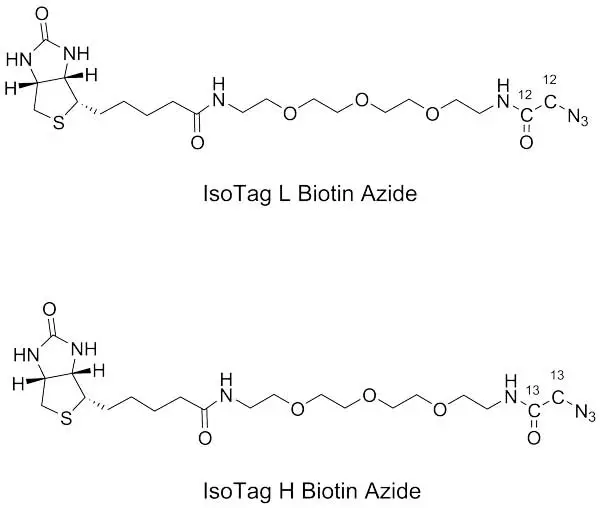
Biotin-PEG3-Azide

Biotin-PEG3-Azide is non-cleavable, azide-activated biotinylation reagent that reacts with terminal alkynes via a copper-catalyzed click reaction, strained cyclooctynes (e.g. DBCO or BCN compounds) via Cu-free click reaction or with phosphine-labeled molecules by a mechanism known as Staudinger chemistry, enabling efficient and specific conjugation of derivatized molecules in biological samples. These reactions are bioorthogonal or in other words compatible with biological systems in that it′s components do not react with the biological environment.

Price range: $96.00 through $1,522.00

SKU Unit Size Price

Select a unit size:

How do I request a quote or bulk pricing?


SKU: CCT-AZ104
CAS Number
875770-34-6
Molecular Weight
444.55
Appearance
White to grey amorphous solid
Chemical Formula

C18H32N6O5S

Purity
>95% (HPLC)
Unit Size
5 mg, 25 mg, 100 mg, 1000 mg
Solubility
DMSO, DMF
Storage Instructions
-20°C. Desiccate
Shipping Conditions
Ambient temperature
Shipping Instructions
Ambient temperature
Selected References
  1. Buch-Larsen, S. C., et al. (2021). Chemical genetics and proteome-wide site mapping reveal cysteine MARylation by PARP-7 on immune-relevant protein targets. Elife, 10, e60480. [PubMed]
  2. Baskin, J. A., et al. (2021). A chemoproteomics approach to profile phospholipase D-derived phosphatidyl alcohol interactions. Cambridge: Cambridge Open Engage, This content is a preprint and has not been peer-reviewed. [ChemRxiv.]
  3. Feng, S., et al. (2021). Combining Metabolic Alkyne Labeling and Click Chemistry for Secretome Analysis of Serum-Containing Conditioned Medium. Chin. J. Chem., 39, 1843-1848. [Wiley Online Library]
  4. Willems, L. I., et al. (2020). Tandem Bioorthogonal Labeling Uncovers Endogenous Cotranslationally O-GlcNAc Modified Nascent Proteins. J Am Chem Soc., 142 (37), 15729-15739. [PubMed]
  5. Daughtry, J. L., et al. (2020). Clickable Galactose Analogues for Imaging Glycans in Developing Zebrafish. ACS Chem Biol., 15 (2), 318-324. [PubMed]
  6. White, F. K. H., et al. (2019). S-Palmitoylation of junctophilin-2 is critical for its role in tethering the sarcoplasmic reticulum to the plasma membrane. J Biol Chem., 294 (36), 13487-13501. [PubMed]