CAS Number 756525-94-7 | |
Molecular Weight 1787.07; single compound | |
Chemical Formula C₈₀H₁₅₅NO₄₁ | |
Purity > 97% | |
Unit Size 100mg, 1000mg | |
Solubility Methylene chloride, Acetonitrile, DMAC or DMSO. | |
Spacers dPEG® Spacer is 112 atoms and 133.9 Å | |
Storage Instructions -20°C; Always let come to room temperature before opening; be careful to limit exposure to moisture and restore under an inert atmosphere; stock solutions can be prepared with dry solvent and kept for several days (freeze when not in use). dPEG® pegylation compounds are generally hygroscopic and should be treated as such. This will be less noticeable with liquids, but the solids will become tacky and difficult to manipulate, if care is not taken to minimize air exposure. | |
Shipping Instructions Ambient |
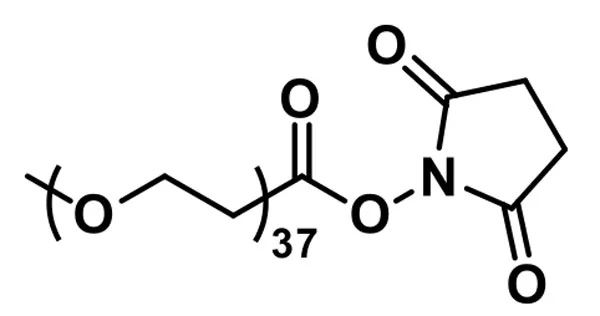
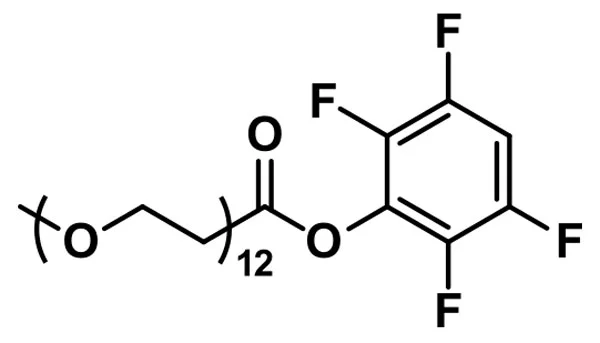
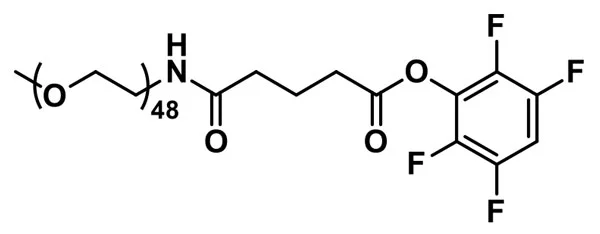
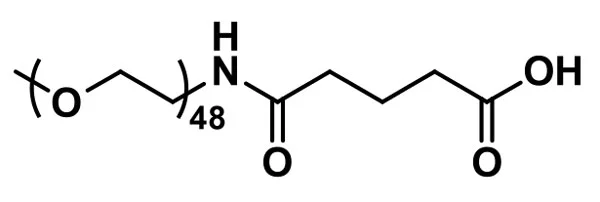
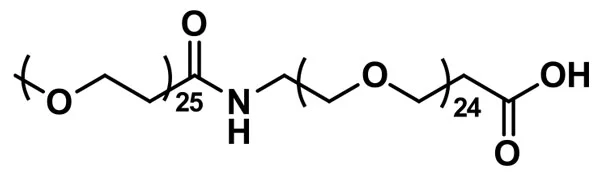
m-dPEG®₃₇-NHS ester
m-dPEG®37-NHS ester, product number QBD-10910, is a long (112 atoms, 133.9 Å), methyl-terminated, discrete-length polyethylene glycol (dPEG®) spacer functionalized with an N-hydroxysuccinimidyl (NHS) ester to modify surfaces having accessible free amines.
Free amines react optimally with NHS esters in aqueous media at pH 7.0 – 7.5. In aqueous media, the rate at which the ester hydrolyzes to the carboxylic acid increases with increasing pH. Moreover, it should be noted that reacting surface amines on biomolecules (e.g., proteins and peptides) with this uncharged, methyl-capped dPEG® spacer may alter the overall charge of the resulting conjugates.
m-dPEG®37-NHS ester, product number QBD-10910, has been used successfully to modify silica shelled quantum dots used in imaging applications to make them water-soluble. Also, it has been employed to improve the pharmacokinetic (PK) and biodistribution (BD) properties of an antibody that targets an epitope that is found exclusively in adenocarcinomas. Carbon nanotubes and inorganic nanoparticles with amine-functionalized surfaces could also be modified to passivate the surface and make it hydrophilic. Moreover, proteins and other biomolecules conjugated to this product will have higher water solubility, reduced or eliminated antigenicity, reduced propensity to aggregate, and improved PK and BD properties.
Price range: $355.00 through $1,311.00
| SKU | Unit Size | Price |
|---|---|---|
Select a unit size:
How do I request a quote or bulk pricing?
Documents |