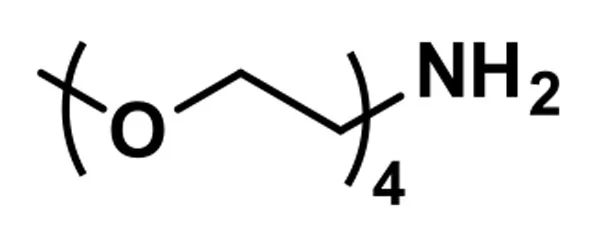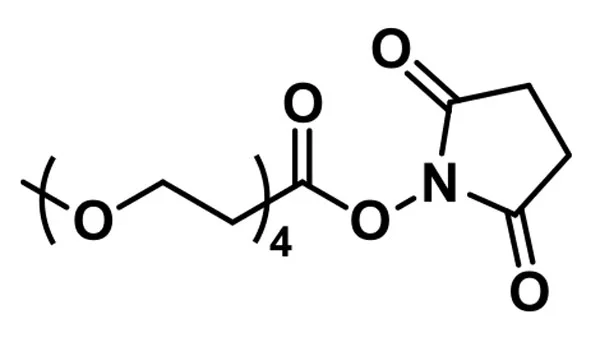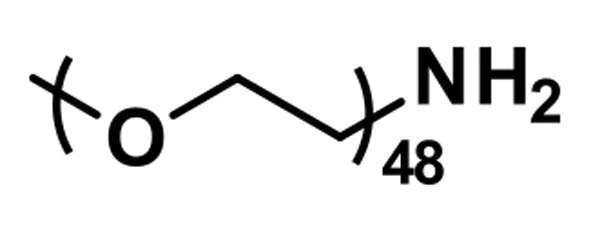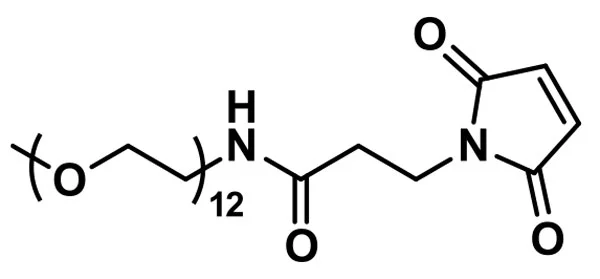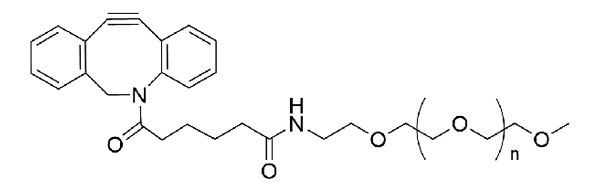
CAS Number 32130-27-1 | |
Molecular Weight 559.69; single compound | |
Chemical Formula C₂₅H₅₃NO₁₂ | |
Purity > 98% | |
Unit Size 100 mg, 1000 mg | |
Solubility Methylene chloride, Acetonitrile, DMAC, DMSO or water. | |
Spacers dPEG® Spacer is 38 atoms and 43.9 Å | |
Storage Instructions -20°C; Always let come to room temperature before opening; be careful to limit exposure to moisture and restore under an inert atmosphere; stock solutions can be prepared with dry solvent and kept for several days (freeze when not in use). dPEG® pegylation compounds are generally hygroscopic and should be treated as such. This will be less noticeable with liquids, but the solids will become tacky and difficult to manipulate, if care is not taken to minimize air exposure. | |
Shipping Instructions Ambient |
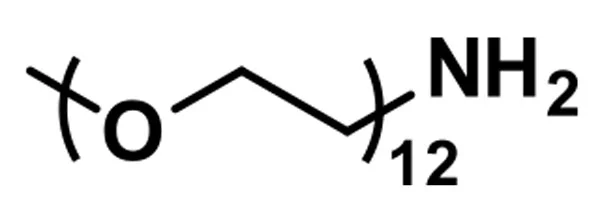
m-dPEG®₁₂-amine
m-dPEG®12-amine, product number QBD-10288, is a non-immunogenic, water-soluble chemical modification reagent. The product contains a single molecular weight, discrete-length polyethylene glycol (dPEG®) chain terminated on one end with a methyl group and on the other end with a reactive primary amine. The amino group reacts with carboxylic acids (and their active esters), aldehydes, and ketones. Reacting the amino group with aldehydes or ketones forms a labile imine (Schiff base). Reacting carboxylic acids or their active esters with m-dPEG®12-amine forms stable amide bonds. Uses for this product include passivating surfaces and coating biomolecules.
Biomolecules modified with m-dPEG®12-amine display enhanced water solubility, increased hydrodynamic volume, and reduced immunogenicity. This product reacts quickly with active esters of carboxylic acids (for example, NHS esters and TFP esters) to form amide bonds. Also, it forms amide bonds directly with carboxylic acids using the carbodiimide EDC.
Several publications in the scientific literature report the successful use of m-dPEG®12-amine. Published reports using this product include:
cancer imaging with a NIR-fluorescent peptosome;
multimodal imaging and targeted gene silencing;
noncompetitive on-chip immunoassays;
antibody pretargeting; and,
the development of biocompatible quantum dots.
Price range: $164.00 through $492.00
| SKU | Unit Size | Price |
|---|---|---|
Select a unit size:
How do I request a quote or bulk pricing?
Documents |