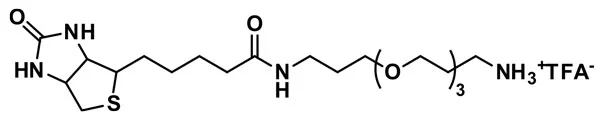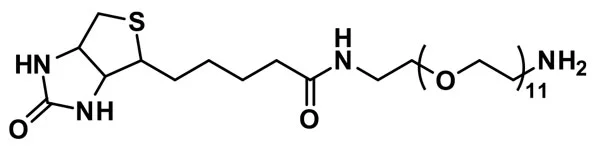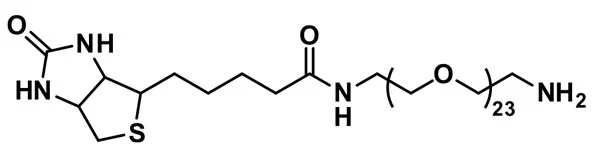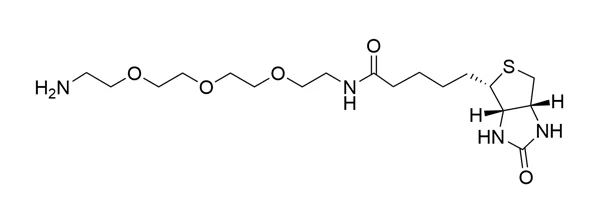
CAS Number 1334172-76-7 | |
Molecular Weight 594.76; single compound | |
Chemical Formula C₂₆H₅₀N₄O₉S | |
Purity > 98% | |
Unit Size 100mg, 1000mg | |
Solubility Methylene chloride, DMAC, DMSO or water. | |
Spacers dPEG® Spacer is 25 atoms and 29.8 Å | |
Storage Instructions -20°C; Always let come to room temperature before opening; be careful to limit exposure to moisture and restore under an inert atmosphere; stock solutions can be prepared with dry solvent and kept for several days (freeze when not in use). dPEG® pegylation compounds are generally hygroscopic and should be treated as such. This will be less noticeable with liquids, but the solids will become tacky and difficult to manipulate, if care is not taken to minimize air exposure. | |
Shipping Instructions Ambient |
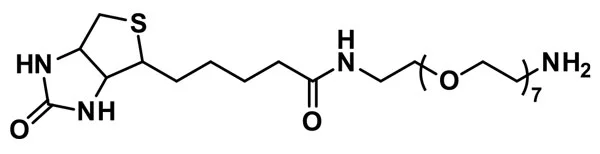
Biotin-dPEG®₇-NH₂
Biotin-dPEG®7-NH2 (Biotin-dPEG®7-amine), product number QBD-10826, is a short (25 atoms, 29.8 Å), hydrophilic, water-soluble, discrete PEG biotinylation product that reacts with carboxylic acids and their activated esters [N-hydroxysuccinimidyl (NHS), 2,3,5,6-tetrafluorophenyl (TFP)] to form stable amide bonds. Additionally, Biotin-dPEG®7-NH2 forms amide bonds directly with carboxylic acids using 1-Ethyl-3-(3-dimethylaminopropyl)carbodiimide (EDC) chemistry. Furthermore, the product can react with carbonyl groups (aldehydes or ketones) to form a labile Schiff base, which can be reduced to a secondary amine using sodium cyanoborohydride for additional conjugate stability.
Amphiphilic biotin-dPEG®7-NH2 dissolves equally well in both aqueous buffer and organic solvent. It is not necessary to dissolve this product in an organic solvent before using it in aqueous reaction media. Furthermore, biotinylation of biomacromolecules with QBD-10826 will not cause aggregation and precipitation. Eliminating aggregation should consequently improve the signal-to-noise ratio of applications developed with this product. Aldehydes are uncommon in biomacromolecules. However, the oxidation of reducing sugars in glycosylated proteins (for example, using sodium periodate) forms aldehydes on the carbohydrate coats of glycoproteins. Reacting Biotin-dPEG®7-amine with aldehydes will produce labile imines or Schiff bases that can be reduced under mild conditions with sodium cyanoborohydride to form more stable secondary amines.
Any application that can take advantage of the strong biotin-avidin/ streptavidin affinity can use Biotin-dPEG®7-NH2. The terminal amine of QBD-10826 offers the opportunity to biotinylate (1) the carbohydrate coat of glycoproteins and (2) surfaces consisting of carboxylic acids or their active esters. Thus, Biotin-dPEG®7-NH2 expands the range of molecules and nanoparticles for which dPEG®-biotin is useful.
Price range: $273.00 through $983.00
| SKU | Unit Size | Price |
|---|---|---|
Select a unit size:
How do I request a quote or bulk pricing?
Documents |