Color of Fluorescence Blue | |
Format Concentrate | |
Formulation 10 mM HEPES, 0.15 M NaCl, pH 7.5, 0.08% sodium azide. | |
Maximum Emission 448-454 nm. | |
Maximum Excitation 345-355 nm | |
Unit Size 0.5 mg | |
Storage Instructions 2-8 °C | |
Usage Summary The recommended concentration range for use is 5-20 µg/ml. If this antibody is to be used in tissues which may contain cross-reacting endogenous immunoglobulins, dilution of this antibody may be made in buffers containing 2% normal serum from the same species as the tissue. | |
Applications Immunofluorescence, Flow Cytometry/Cell Separation | |
Target Species Human | |
Concentration 1.0 mg active conjugate/ml | |
Conjugate AMCA | |
Reactive Species Goat | |
Source Species Human | |
Host Species Goat |
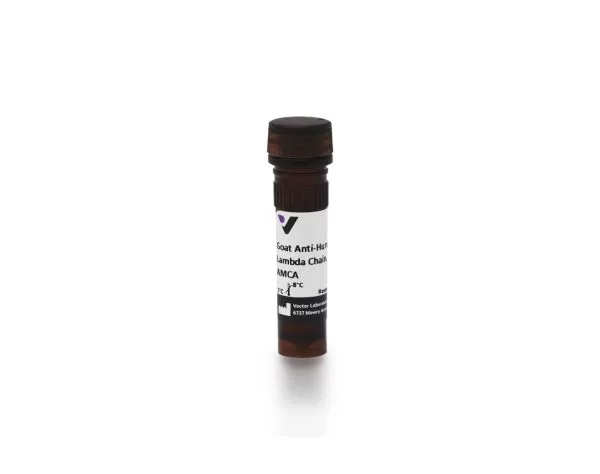
Goat Anti-Human Lambda Chain Antibody, AMCA
AMCA (7-amino-4-methylcoumarin-3-acetic acid) labeled Goat Anti-Human Kappa Chain Antibody is a chain-specific antibody, which distinguishes between chains or classes of target immunoglobulins. This lambda chain specific antibody has virtually no cross-reactivity with other immunoglobulin classes or other heavy or light chains.
Features:
• Optimally labeled with AMCA to provide the brightest label for fluorescence microscopy
• Can be used for flow cytometry or used for tissue staining
• Supplied in solution
• Excitation: 350 nm
• Emission: 450 nm
• Color: Blue
$210.00
| SKU | Unit Size | Price |
|---|---|---|
Select a unit size:
How do I request a quote or bulk pricing?
Technical Information The goat anti-human Ig antibodies are prepared by hyperimmunizing animals in a manner that produces high affinity antibodies. These are then purified by an affinity chromatography procedure designed to remove any low affinity antibodies which may be present. Cross-reactivities that are likely to interfere with specific labeling are removed by solid-phase adsorption techniques. The final product is then subjected to rigorous quality control assays including immunodiffusion, solid-phase enzyme immunoassays, gel electrophoresis and solid-phase binding assays. In preparing the labeled antibodies, great care is taken to ensure the maximum degree of labeling with no alteration in the specificity and affinity of the antibody. The labeled antibody then undergoes a further series of quality control assays, including immunohistochemical analysis. |